|
The Alabaster ChronicleThe Journal of the Alabaster Society
NUMBER EIGHTEEN, SPRING 2002 |
|
The Alabaster ChronicleThe Journal of the Alabaster Society
NUMBER EIGHTEEN, SPRING 2002 |
Contents
|
Editorialby Laraine Hake - March 2002 Welcome to Alabaster Chronicle Number Eighteen! I hope you will find this one varied and interesting. I must take this opportunity of thanking the various contributors and letter writers who have made this possible. The new Alabaster Book, the Alabaster Society's very own contribution to historical memorabilia of the future, is well under way. Special thanks go to Ron Alabaster West for his hard work with this venture and to all of you who have contributed to such a worthwhile project. I am sure you will agree that we are very lucky to have the opportunity to make our own record for the future in this unique way! All things being equal (just a minor hospital operation taking place in the second week of April), Ron will have the Alabaster Book available for its first viewing at the Gathering at the end of that month. As you will know, such interest has been shown in the end product that we have decided to make a photocopy of its contents available in book form for purchase by a select few……..namely our members who have contributed! You will all have received notification of this, and obviously had the opportunity to let us know if you do NOT want your contribution included in such a copy. To my knowledge, nobody has declined to be included, and there has been a lot of interest in buying copies. We had hoped to have order forms available with this Chronicle, but have taken the decision to postpone them until September because it has taken longer than anticipated to collect all contributions (so if yours is still on your desk, you do still have the chance of not being excluded)! Copies of the most recent Society accounts are included with this Chronicle. Do study them and bring them with you to the Gathering if you wish. The next Alabaster Gathering is the most pressing Alabaster item on my mind at the moment. There are further details on pages 42-44 and a letter of confirmation of your booking and a request for balances due enclosed if you have already booked to come. However, I certainly do not want to alienate any of you who cannot be there by talking about it too much…………that will be in the next edition I expect! As ever, I hope all is well with you and your families. I look forward to seeing many of you soon, and hearing from those of you who I do not see in person. Please keep the letters and emails coming in! To Contents |
Sidney Herbert Alabaster (IIA)by Laraine HakeMy father's mother was born Adeline Bertha Alabaster on 30th January 1881, in Bethnal Green. My father, Leslie Victor Oram, was her youngest child, born thirty-eight years later in Walthamstow. Despite being the son of an Alabaster, my father has very few memories of meeting any of his Alabaster relations as a child; just a fleeting memory of his grandmother and her eldest daughter, Aunt Emily, and a slightly stronger memory of his mother's younger brother, Sidney Herbert Alabaster. My Uncle Alf, my father's older brother, wrote an article describing a visit from his "Uncle Sid" in about 1923 (Alabaster Chronicle No. 8). He remembered that Uncle Sid was a "master builder ……..he built many houses in Bexleyheath, Kent". Apparently this was not the only occasion on which Uncle Sid visited. My father says he remembers these visits as annual events throughout his young childhood, taking place just before Christmas each year, when Sid would arrive with his wife, "Aunt Daisy", bringing a parcel of Christmas goodies and a bottle of whisky in a beautiful Vauxhall car, an open tourer with a hood. 1891 - 1 Clyde Terrace, Leyton
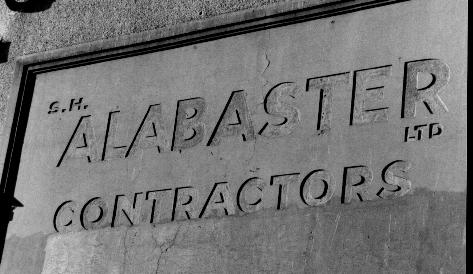
During the early months of last year, 2001, Lesley Harvey-Eells (IIIA) told me that she had noticed some words in the plasterwork on the side of building in Welling, overlooking the ground of Welling United Football Club, whilst waiting for a bus. It was largely obscured by a billboard but appeared to be the name ALABASTER! Lesley attempted to take a photograph of the wall, but was more successful later in the year. On 3rd June she sent me an email: "Just got my Alabaster photos (of the Contractor's wall) back from the chemist after all this time. They are very good as there is no billboard in front of the sign. Will put in the post tomorrow." |
News from Around the WorldMurray Williamson, Australia 1st October 2001 Beryl Cathro, Australia (I) 15th October 2001 Erica Alabaster, Wales (IIB) 20th October 2001 John Lee, husband of Christine Lee, nee Alabaster (1946-2001) (IIA) 7th November 2001 Two very sad messages. I am sure the thoughts and prayers of all of our members are with you both at such a sad time. - Laraine. Denis Alabaster, Essex (IIIB) 10th December 2001 Stephen Alabaster, Birmingham (IIA) 6th December 2001 Dear Mrs Dyer, Stephen Alabaster (IIA) 11th December 2001 Linton Love, Canada (Roger) 2nd February 2002 http://freepages.genealogy.rootsweb.com/~linloveThat URL will take you to the basic Home Page. Note there is NO www in the URL. From the Home Page you can scroll
to the end where you will find a hot link to the SMITH FAMILY page. …You will be interested in the first 3 generations
because it deals with the Smiths in Hadleigh. You will also see some familiar pictures which you will recognize as
from Mr Jones book. If you run out of things to do and get curious about the LOVE FAMILY page I hope it won't be
until I have cleaned it up, "tweaked" is the buzzword. To Contents |
Captain Daniel Alabaster of New Zealandby John Stammers Alabaster (I)A brief talk on Captain Daniel Alabaster (Branch IV) was given at the first Alabaster Gathering at Hadleigh in 1990, together with a few written notes that included mention of Lake Alabaster in New Zealand, named after him. The following year Robin Alabaster and his son, Nicholas visited the lake and published a graphic description of their adventures (1 & 2), and also a footnote provided a few further biographical details about Daniel. There has been some other gathering of information about this branch of the family, and so I now take the opportunity to expand the written record and provide a few more details and some references. The branch is, incidentally, the first to have been established in New Zealand (in 1854), the second one of the 19th century being Branch IIC (in 1859), as represented by the Rev. Charles Alabaster and his wife Annie; they were also mentioned briefly at the Gathering, and references to accounts of their lives and those of some of their famous cricketing family are given in the Preface to Adrian Alabaster’s book on some notable Alabasters (3). Family connections
|
Another New Zealand Connectionby Laraine HakeIn the autumn of 1994, Marg Francis (IIC) wrote the following in Alabaster Chronicle No.3: When Charles Alabaster emigrated to New Zealand in 1858 he was 25, his wife Ann O’Connor just 16. They had been married only weeks when they set sail on the "Strathallen" because Charles was suffering from tuberculosis and had been told a long sea voyage was his only hope of recovery…………………………The couple arrived in Christchurch on January 22 1859……………….. For a time Alabaster was employed as Chaplain to the Bishop. However he never fully recovered from the tuberculosis and………..was forced to retire. The Alabasters, who now had two sons…….needed an alternative source of income. A school was a logical step. In January 1862, Lincoln Cottage Preparatory School, which catered for boys aged 5 to 10, both boarders and dayboys, was opened. Ann mostly ran the school, with help from Charles when his health allowed. The curriculum was considered advanced for its day. Examinations, which were held annually, were conducted by Anglican clergy. Lincoln Cottage soon established a sound reputation. The Headmaster of Christ’s College described it as the best means of training for Christ’s College. Many leading citizens sent their sons there. Tragically, but not unexpectedly, Charles died in January 1865. In spite of his ill health he had been active in civic life…………..There is a plaque to his memory in (the cathedral). Ann continued to run the school until 1881…………… An Alabaster prize and scholarship were set up at Canterbury University in their memories. To ContentsIn October 2001, I received an email from Murray Williamson in A.C.T. Australia, explaining that his wife, Judith (nee Rodd) was descended from the Alabaster family who lived in Rayleigh in the 19th century. New Zealand Connections – further comments
|
|||||||||||||||
William ALABASTER b. 1689 Claydon, Suffolk; d. 1768 Baylham, Suffolk m. 10 Apr 1721 Sarah STEGGELL   |
||
William ALABASTER b. 1726 Claydon, Suffolk; d. 1768 Baylham, Suffolk m. 7 Feb 1753 Martha COCKERELL |
‹ brothers › |
Robert ALABASTER b.1732 Claydon, Suffolk; d. 1796 Bramford, Suffolk m. 26 Nov 1754 Ann MISON |
John ALABASTER b. 1762 Claydon, Suffolk; d. 1828 Rayleigh, Essex m. 24 Mar 1792 Ann BURROWS |
‹ first cousins › |
Charles ALABASTER b. 1775 Bramford, Suffolk; d. 22 Feb 1820 London m.6 Sep 1803 Mary DEARMER |
Ann ALABASTER b. 1800, Rayleigh, Essex; d, 17 Dec 1879 Chelmsford, Essex m. 10 Aug 1824 James RODD |
‹ second cousins › |
James Chaloner ALABASTER b. 24 Oct 1806 Shoreditch; d. 22 May 1840 London m. 10 Aug 1830 Sophia Harriet WOODMAN |
Mary Fox RODD b. 1840 Rayleigh, Essex; d. 1919 New Zealand m. Frederick Denhame GIBSON b.1831; d. 1915 |
‹ third cousins › |
Charles ALABASTER b. 1833 Westminster; d 18 Jan 1865 New Zealand m. 29 Sep 1858 Anne O`Conner WARNER b. 1842 Oxford; d. 1914 New Zealand |
As newcomers to the Alabaster Society, my wife Judith and I were interested to read Marg Francis’s account of Rev Charles Alabaster and his wife Ann, who established the Lincoln Cottage Preparatory School in Christchurch in 1861. We knew that several of Judith’s relatives, named Gibson, descended, like her, from Ann Alabaster, were also prominent in education in Christchurch.
I contacted Marg Francis, who was unaware of this further Alabaster connection with education in Christchurch. She suggested that I get in touch with Rangi Ruru a leading girls school in Christchurch. The school kindly gave me a copy of their history, and it filled in the gaps in my knowledge. It is clear that Alabaster descendants have made a remarkable contribution to education in Christchurch and beyond.
Ann Alabaster (Branch I) married James Rodd in 1824 in Rayleigh Essex. James was an auctioneer, and held the position of clerk of the parish for thirty years. They had twelve children. Two of their sons went to Australia and set up the Free Trade Stores in Braidwood, New South Wales, to service the gold miners and farmers in a boom era. James died on 1 July 1862 and was buried in Rayleigh. In 1863 the newly-widowed Ann set out on the Intercolonial Steamship Company’s Auckland with her youngest daughter, Mary Fox Rodd, to visit her boys in Australia. (Judith is a great-grand daughter of one of these boys).
On the way out, Mary fell in love with the ship’s captain, Frederick Denhame Gibson. His first wife had died in 1861,
and he had a six year old son back in England. Frederick and Mary married at St Saviour’s Church, Goulburn, New
South Wales on 29 October 1863. Ann Rodd, nee Alabaster, must have found her way back to England at some stage,
because she died in Chelmsford in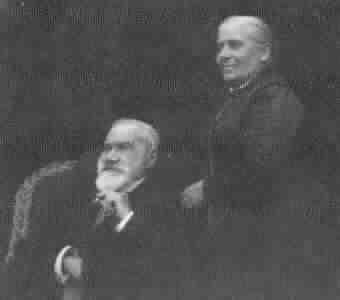 1879.
1879.
The Gibsons settled at Lyttleton, New Zealand, and had ten children. According to the New Zealand Dictionary of Biography, Mary was a forthright woman who saw to it that her daughters had an education equal to that of her sons. Several received a University education. Mary is quoted as saying to her husband "You know, dear, we have so much to be thankful for, we have eight daughters and two nice boys".
When the family fortunes sagged, in 1887, Mary commenced to supplement the family income by taking private pupils. In 1889 Captain Gibson purchased a small private school in Christchurch, and Mary and daughters Helen and Alice started off with eighteen girls aged from 5 to 16. Helen, not yet 21, was the principal. Her brothers called it Nell’s Academy; officially it was Miss Gibson’s Private School for Girls; unofficially it was Gibsons or Gibbies; and in 1891 Captain Gibson called it Rangi Ruru (wide sky shelter) at the suggestion of a Maori friend.
Sisters Ruth, Lucy, Ethel and Winifred also taught at the school at various times. Brothers Fred (a doctor) and Tom (manager at the Farmers’ Co-op) were consulted on major decisions.
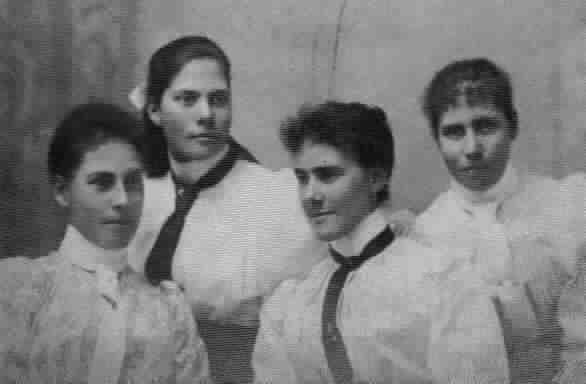 Ethel, Winifred, Lucy and Ruth
Helen died on 24 July 1938, after nearly 50 years as Principal. In St Mary’s Church, Merivale there is a stained glass window in her memory and two brass plates commemorating her and her mother, Mary Fox Gibson.
After Helen’s death, Ethel became Principal at Rangi Ruru, but Ruth and Winifred continued to assist her. The three sisters finally retired in 1946 when they sold the school to the Presbyterian Church. On its centenary in 1989 Rangi Ruru had an enrolment of 700, with over 150 boarders.
Mary Gibson, MA, another member of this redoubtable family, became Headmistress of Christchurch Girls’ High School in 1889, a position which she retained until she retired in 1928, when the school had over 600 pupils. She died on 1 September 1929. In 1893 she signed a petition which led to the enfranchisement of women in New Zealand.
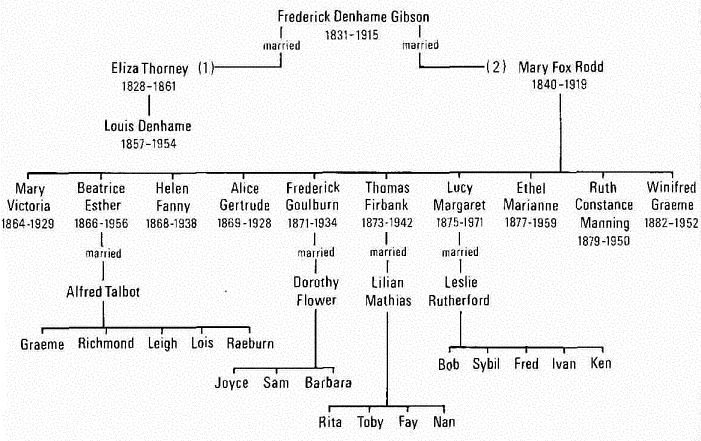
Beatrice Gibson MA became Headmistress of the Nelson College for Girls in 1890. She tried to avoid marriage interfering with her career and resigned in 1900 in order to travel, but Dr Alfred Talbot, Superintendent of Nelson Hospital and a former student with Beatrice at Christchurch University, pursued her to England, and married her there.
A remarkable story I think. I wonder if the Gibsons were aware that the Alabasters in Christchurch were related to them? I am inclined to think so. Mary Fox Rodd was the same age as Ann Conner Alabaster. In 1874 Captain Gibson took Mary and their six children and nanny back to England for two years to visit relatives, so that Mary must have been aware of her Alabaster connections. (I wonder how the relatives felt, being invaded by this small army for such a long period)!
So far we have not located current descendants of Mary Fox Rodd.
Henry Alabaster’s Account of the
|

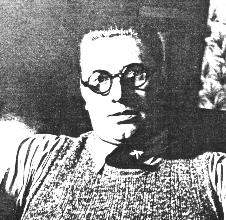 Tony's "mum's brother, Bert" was actually Herbert Sidney Alabaster, son of
Sidney Herbert and father of Tricia Dyer. I was to hear about him, from a
completely different source, later in 2001. See Laraine's Letter (
Tony's "mum's brother, Bert" was actually Herbert Sidney Alabaster, son of
Sidney Herbert and father of Tricia Dyer. I was to hear about him, from a
completely different source, later in 2001. See Laraine's Letter (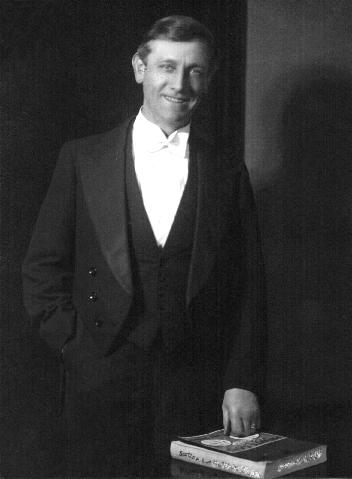
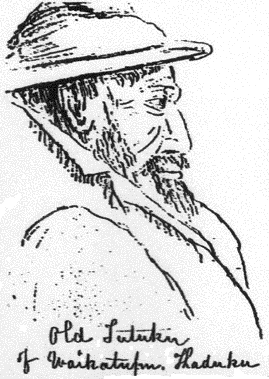 who had been
living there for the past five years with his two daughters (8). Daniel
‘christened’ these girls, Sara and May, and all three names are now
immortalised in the surrounding Mount Tutoka, Sara Hills and May Hills
(Fig. 3), so named by Dr. Hector (later Sir James) who arrived in the area a
few months after Captain Alabaster and his companions. Daniel did not
continue on his travels until he had done what he saw was his Christian
and moral duty and replaced the somewhat scanty flax mats which served
as dresses for the two young girls (probably like kilts, with the ends
hanging down loosely(10)) by some more seemly garments - made from a
material which came readily to the hand of a sailor, namely, a light
canvas, not a very comfortable material for a garment.
who had been
living there for the past five years with his two daughters (8). Daniel
‘christened’ these girls, Sara and May, and all three names are now
immortalised in the surrounding Mount Tutoka, Sara Hills and May Hills
(Fig. 3), so named by Dr. Hector (later Sir James) who arrived in the area a
few months after Captain Alabaster and his companions. Daniel did not
continue on his travels until he had done what he saw was his Christian
and moral duty and replaced the somewhat scanty flax mats which served
as dresses for the two young girls (probably like kilts, with the ends
hanging down loosely(10)) by some more seemly garments - made from a
material which came readily to the hand of a sailor, namely, a light
canvas, not a very comfortable material for a garment.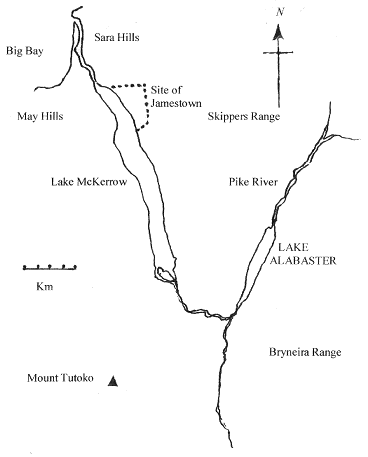 a further
expedition was mounted from Lake McKerrow, up the Pyke
River (Fig. 3); this led to the discovery, not of gold, but of a
small and particularly beautiful lake with snow-white
beaches, surrounded by bush-clad hills - Lake Alabaster,
as it is still known today, with the Skippers Range rising
from the western shore-line and the Bryneira Range from
the south-eastern side (8) (Fig. 3).
a further
expedition was mounted from Lake McKerrow, up the Pyke
River (Fig. 3); this led to the discovery, not of gold, but of a
small and particularly beautiful lake with snow-white
beaches, surrounded by bush-clad hills - Lake Alabaster,
as it is still known today, with the Skippers Range rising
from the western shore-line and the Bryneira Range from
the south-eastern side (8) (Fig. 3).