|
The Alabaster ChronicleThe Journal of the Alabaster Society
NUMBER NINETEEN, AUTUMN 2002 |
|
The Alabaster ChronicleThe Journal of the Alabaster Society
NUMBER NINETEEN, AUTUMN 2002 |
Contents
|
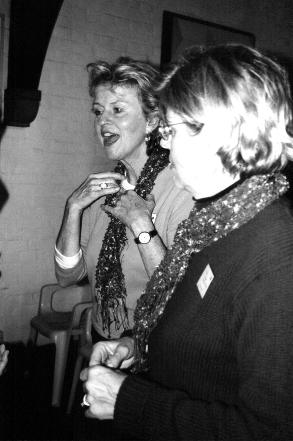
by Laraine Hake - October 2002Welcome to Alabaster Chronicle Number Nineteen! I hope you will find it filled with a variety of different types of information, some of which, at least, you will really enjoy. 2002 seems to have passed so quickly. Already it is the end of October: the lawns are covered in leaves and the nights are drawing in. I do hope that it has been a good year for most of you and that your positive experiences outweigh the negative ones. As far you will see from the News Pages, the Alabaster family is still doing its level best to populate the world, with several new Alabaster descendants being born. Within the same pages you will see that the Alabaster family really does seem to have had a go at spreading over the whole of the globe - our latest communication having arrived from an Alabaster of Argentian descent! The Sixth Alabaster Gathering did turn out to be a positive experience for many, judging by the correspondence that I received after it. It is reported in detail further in this Chronicle. Just at the moment, I am not sure how we will equal it, let alone better it…………but 2005 is a long way away! Those of you who saw the amazing Alabaster Book, produced by Ron Alabaster West and his family, from your contributions, will doubtless have already completed the enclosed form ordering your own copy. Make sure that it is sent direct to Ron. There is also this year's subscription renewal, which should be sent to Robin. At the end of August, I met up with Oriole Veldhuis and her sister, Faye, who were visiting UK from Canada, and happened to be staying in Norwich for two nights. We had a great day together in Hadleigh, actually trying out Sue Andrews' walk, (page 38), which is when I took the photographs. Oriole and Faye are descendants of Mary Ann Rebecca Alabaster, branch IIC. My apologies that this edition is somewhat behind my self-imposed schedule. The pressures and time needed for school do seem to have grown dramatically of late! Thank you to all those who have contributed to the Chronicle, whether by letters, articles or their own personal reminiscing. I would really appreciate further contributions of these types, as well as your general support! To ContentsNews from Around the World
John and Shirley Alabaster (IV) May 2002 Audrey Tilling (nee Alabaster) (IIA) May 2002 Eileen Fowler (WofW) 13th June 2002 Betty (Alabaster!) West (IV) 23rd July 2002 Alan Alabaster, Crawford, Canada (IIIA), 7th August 2002 Angela Alabaster (IIA), 7th August 2002 Robbin & John Churchill, 9th August 2002 John and Shirley Alabaster (IV), 23rd September 2002 Jorge Alabaster (IIA), Argentina, September 2002 To Contents |
In Search of the Alabaster Family Home in Hadleighby Sue AndrewsAs part of my research into the Alabaster family during the sixteenth and seventeenth centuries, I set myself the task of discovering the extent of Alabaster property in Hadleigh, Suffolk, and in consequence was able to identify the site of the family home. I began by looking for Thomas Alabaster in Hadleigh Archive and soon discovered that he had lived at the north end of the town. In 1580, he had become responsible for Hadleigh Bridge Street in a new neighbourhood watch scheme that reported any undesirable strangers to the authorities. (This old street name represents the northern portion of the present High Street and the roads now called Bridge Street and Gallows Hill that lead out of the town towards Kersey.) A sketch map of the town dated 1668 shows ALA BLASTES LAND as being to the west of Hadleigh Bridge Street. I knew then with which area of the town I was dealing but the next clue, the name of the property, still did not fix its exact location. During the sixteenth and seventeenth centuries, clothiers like Thomas invested in real estate in order to safeguard their wealth and make provision for the next generation, so I obtained photocopies of Alabaster Wills from the Public Record Office at Kew. In his Will drawn up in 1591, Thomas refers to various lands and tenements in Hadleigh and Kersey, which are shared out amongst his two sons, his brother and a daughter still living in Hadleigh. However, he does not mention the capital messuage where I dwell, a phrase often used by testators to indicate their head house. As a widower, Thomas might have already handed over his home to the next generation in return for accommodation and care during his remaining years. The Will of his second son John made in 1637 and the subsequent Inquisition post mortem tell us that Thomas had made provision for the inheritance of the family home in 1584 when John had married Mary Brond of Boxford. This marriage settlement was recited in John's Will and confirmed that Mary would be able to enjoy her widowhood … the Mansion House … wherein I now dwell with my lands called Hannams lying at the end of the Towne going towards Karsey. The IPM recorded that according to an indenture dated 1629, the property was to pass on Mary's death to their eldest son John II and his male heirs. Unfortunately, Hannams is not a property name known in Hadleigh today and there were no indications as to when or from whom it had originally been purchased by Thomas. As I needed to know the familial relationships beyond the Alabaster name, I consulted the usual genealogical aids, which told me that the year, 1629, had heralded the birth of John III. Seven years earlier, John II had married widow and mother of two young boys, Sibilla Britten, but it was not until there was a male Alabaster heir, John III, that the property was settled upon John II and Sibilla. Continuing with Wills, apparently John III had married Bridget Bull but predeceased his father in 1654, leaving a baby daughter named Sibilla after her grandmother. This lack of a male heir necessitated John II making a Will in favour of his granddaughter who was to inherit all my lands and tenements at age twenty-one or day of marriage, whichever event was first to occur. John II had nominated his daughter Mary, wife of William Gilbert, Rector of nearby Brent Eleigh, as sole executrix, but she renounced this task in favour of John III's widow Bridget. In 1659, Bridget, as mother of the heir Sibilla and now wife of Robert Appleton esquire, obtained probate of her first father-in-law's Will and began to receive the rents and profits of the real estate, which she would have to apply to the maintenance and education of her daughter. The family home had now been traced through four generations, from 1584 to 1659, but with Sibilla's eventual marriage, the property would move out of Alabaster ownership, and, still, I was unsure of the site! I then turned to manorial records held at Bury St Edmunds Record Office and soon found that the site of the Alabaster home came under the jurisdiction of three of Hadleigh's five manors. In 1651, John II acknowledged ownership of a freehold tenement called Langhams. Was this Hannams by another name? Struggling with unyielding, dusty Latin court rolls and rentals, it was not through the name Alabaster that I tracked down the family home however. Firstly, I followed the name of Robert Appleton, who in 1661 held a messuage late in Mr Alabsters occupacion and then George Hunlock, who held the same property in right of his wife late Alabaster in 1685. As Robert Appleton was paying manorial rent on his wife's behalf, it would seem that he and Bridget, whom he had married in 1656, were living here with her daughter Sibilla Alabaster. George Hunlock, a London milliner, was in a similar position having married Sibilla in 1672. Knowing that the name Hunlock was involved in the property, I was pleased to come across the name when undertaking completely unconnected research at Ipswich Record Office. At the bottom of a box, full of the dirtiest parchment I had ever seen, was the trust deed, dated 1675, confirming property upon Sibilla and George and their heirs but, for want of issue, it was to remain to the son and three daughters of Bridget and Robert Appleton. The document described several pieces of real estate and it began to dawn upon me that I was not dealing with one house but a complex of buildings including the capital messuage wherein John Alabaster gent lately dwelt called the Bridge House. A swift visit to Bridge Street in Hadleigh left me very disappointed. The present Bridge House, now the nearest building to the bridge, had been the office of the town's former Gas Works originally opened in 1861. Many of the buildings within the vicinity of the bridge had been demolished over the years, so had the Alabaster family home gone long ago? Being a person who likes to follow through to the bitter end, I decided to continue tracking the Alabaster Bridge House by tracing Sibilla and George's only child Anne who was married in 1718 to Daniel Lock, a cheese factor (merchant) of Ipswich. It would seem that the Alabaster properties were sold off in two stages; firstly in 1712 by Sibilla Hunlock at the death of her husband George, and later in 1731 by Anne Lock, after the death of her mother Sibilla. Although there was no further Alabaster connection with Bridge House, the search continued for its site. I had already noted from Hadleigh's tithe map of 1839 and its accompanying schedule that a Thomas Gray occupied several fields that John II had once owned together with a site in Bridge Street that was not fully shown on the map as it was partly free from tithe rent. Nearly eighty years earlier, in 1762, another Thomas Gray bequeathed his house and malting office to his wife Jane and a document dated 1764 told me that Widow Gray had paid manorial rent on late Hunlocks late Alabasters. Could I assume that Thomas Gray's part of an extensive site north of the river and to the west of the road included the location of Bridge House? When Babergh District Council took over the site in 1979, many outhouses and sheds were demolished but five substantial buildings of various architectural styles and dates, including a former malting, were cleverly linked to new structures in order to provide the Council with offices. To fill in the gaps between 1839 and the present, I consulted editions of local directories and followed the malting office from Thomas Gray, through the nineteenth century to Ernest Gayford in 1904. Gayford was a maltster and corn, coal and seed merchant who lived next to his Bridge Street malting in … Bridge House! |
A Remote Connection between Alabastersby John S. Alabaster (I)One wonders whether Dr. William Alabaster (1568-1640), who held the living of Therfield, near Royston,
Hertfordshire from 1614 until his death, was aware of the distant connection between an early Alabaster and the
chantry chapel attached to the north side of the chancel of St. Mary’s church, Therfield, which was still extant in his
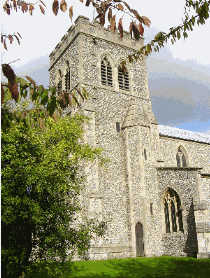
day and remained so until 1676. The chapel had been endowed in 1420 by William Paston, a successful lawyer, on the occasion of his marriage to Agnes, heiress of Sir Edmund Berry of Horwelbury, in the neighbouring parish of Kelsall, and was donated in memory of William’s father, Clement, as recorded in one of the windows . Clement was an interesting character, an industrious peasant who believed in education and had borrowed money to send his son William to school and subsequently, with the help of his brother-in-law, to London to study law. William’s son, John Paston married Margaret Mauteby, a remarkable personality who often had to look after the affairs of the family in East Anglia under extremely difficult circumstances when both her husband, and then later her eldest son, were often away from home. This is all recorded in over a thousand family documents that have since been published as The Paston Letters . They speak of wrongful and violent claims to Paston property, a time of civil strife leading to the Wars of the Roses, several periods of imprisonment for her husband and overseas military service for her eldest son. Among the documents are more than thirty letters covering the years 1450 to 1477 in which James Arblaster is mentioned. (Incidentally, for two of them, the spelling is transcribed ‘Alblaster’). A few of these were written by Elizabeth, Countess of Oxford, to whom he seems to have been related by marriage through the Waltons and for whom he was a loyal and valued friend. Tony Springall has already detailed James’ involvement with the de Vere family as well as other aspects of his life. The remainder of the documents were concerned with James’s activities with the Pastons with whom he was also distantly related. His wife Agnes’s first husband was Robert de Wychingham whose father, Edmund, was a cousin of John Paston and this is consistent with Margaret Paston’s reference to James as her cousin in one of her letters. James acted, amongst other things, as: peacemaker within the family; agent in negotiating rents; accountant; family advisor; administrator of John Paston’s will; and active supporter of John’s son, Sir John, as prospective member of parliament for Maldon. Is it likely that Dr. William Alabaster knew of James and of this connection with the Pastons? My guess is that he did. Firstly, I assume that his statement ‘My father’s people belong to the ancient and noble Alabaster family who came to England with the Normans’ has some truth in it. At least the family must have been able to trace its history well back beyond its arrival in Hadleigh, Suffolk, not just to William’s grandfather William of Worsted, Norfolk, but perhaps even back to those Alabasters of Worsted mentioned in the Domesday Book (although there is no evidence to support their having been among the landing party with William the Conqueror ). It is also likely that they would also have known something of their less closely related namesakes living in East Anglia. Secondly, as Tony Springall has pointed out 3, James had two known connections with Hadleigh: in his will he mentioned Archdeacon William Packenham, the builder of the Deanery Tower in Hadleigh; and there was also the association of James’ son with the nearby village of Neyland, Suffolk. A further possible connection relates to a letter from a servant of James to John Paston, ‘Writen at Hadley’ 2 in the year 1494. Finally, and perhaps most importantly, three descendants of James entered Gonville and Caius College, Cambridge: Edmund Arrabraster in 1564 and two of Edmund’s nephews, Alablaster Wentworth in 1585 and Thomas Mallowes in 1597 . It is hard to imagine that William Alabaster would not have met the latter two in Cambridge, bearing in mind that he entered Trinity in 1583, and at least through them would have known of Edmund Arrabaster and Edmund’s great-grandfather, James Arblaster, and his links with the Paston family. So, I picture William inspecting the chantry chapel in his church for the first time, reading the inscription there and then suddenly making the distant connection with the legendary James, remembering the family lore about him, and perhaps also reflecting on how times had changed so much since those days. To ContentsAlabaster Gathering – Number Six
|
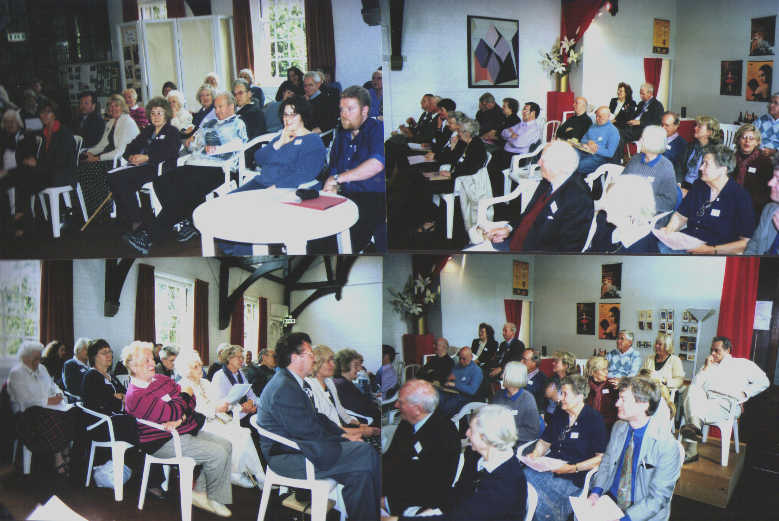
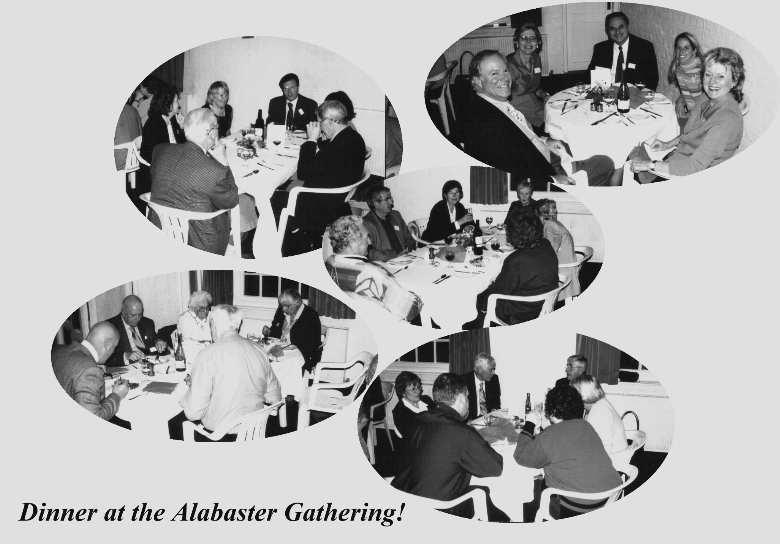
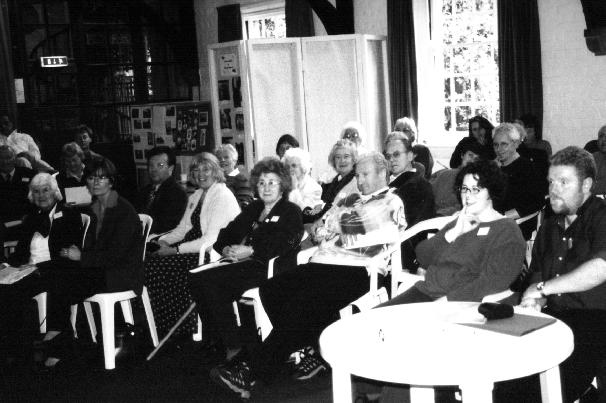
Tricia Dyer (IIA) 29th April 2002: *********************Sunday morning at 9.15 am saw a full coach leave the Magdalen Road car park in Hadleigh, bound for Norfolk. Actually, it was not totally full, which was fortunate, as our first stop was at The Holiday Inn, Bramford Road, to pick up Charlotte and Moe Alabaster who had travelled from Florida to join us. In fact, they were due to fly on to Geneva on that Sunday, but had changed their arrangements to allow them to join us on our trip. Moe’s father, Sydney William Alabaster, had been born in Gt Yarmouth in 1887, so our visit to this town was likely to be of special interest to them. I had intended that members of the coach party would answer a quiz as we travelled, but everybody was so busy talking and generally socialising, I decided to give this a miss! However, I did interrupt to point out when we passed near to Alabaster places of interest. Our coach driver was particularly good, and nobly detoured from the main A12 so that we could pass through Saxmundham and I could point out land owned by the Alabaster family in the 18th century, as well as the church in the distance on the outside of which there is a memorial to the Alabasters. We again left the A12 for another detour later, so that we could pass by the church in Kessingland where the older children of Robert and Mary Ann Alabaster were baptised, between 1808 and 1812, prior to their move to Gt Yarmouth, where they were living by 1814. The coach dropped us outside the Star Hotel, Gt Yarmouth at 11.15 am. Half of the party made their way to the English Heritage property, the Merchants House and Row 111, for a guided tour of a typical Yarmouth home in the 19th century, whilst the other half of us were met by Yarmouth local historian, Colin Tooke, who took us on a tour of the part of the town in which the Alabaster family lived over one hundred years ago. We met up again at 12.30pm, back at the Star Hotel, for an excellent meal in their Carvery. A good time really was had by all. Charlotte Alabaster 8th May Florida, USA: At 2.00pm we reboarded the coach for Worstead. As Tony Springall had told us the previous day, John Alblaster and his wife were responsible for the erection of the screen in Worstead Church at the end of the 15th century, and there is a brass memorial to John on the floor of the church, just in front of the screen. (Thomas Alabaster of Hadleigh, our shared many times great grandfather (11 gts for me!) inherited land in Worstead in 1562, so there is definitely a connection, even if we cannot be 100% specific on its nature).
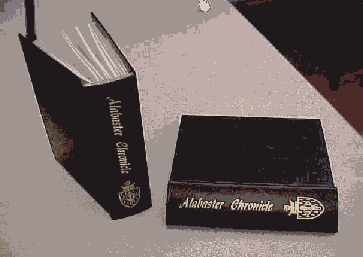
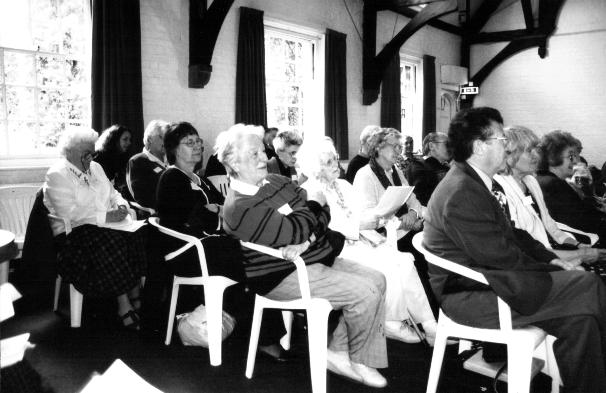
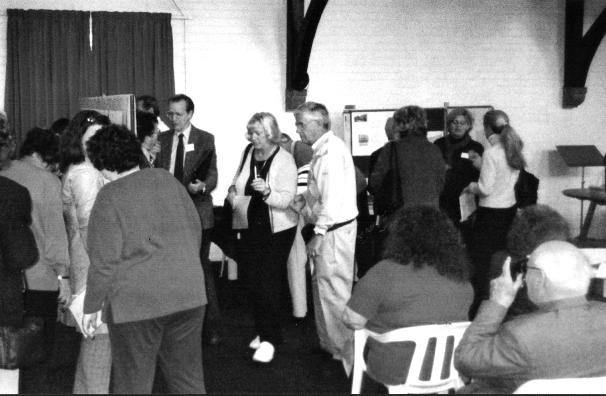
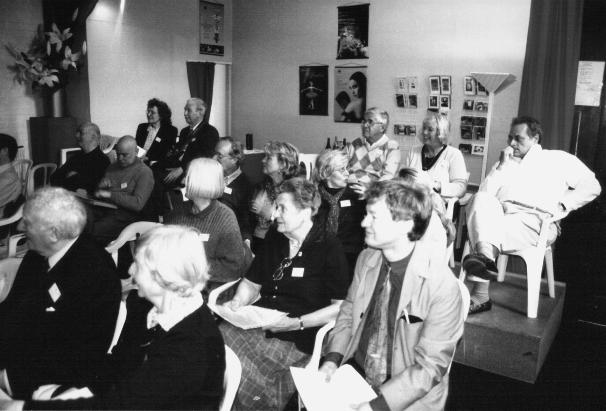
Stephen Alabaster (IIA) 7th May 2002: On the return journey to Hadleigh by coach, I did manage to make everybody work by involving the party in one of my quizes………a lighthearted version of Dingbats, all answers being books, musicals or plays. It provided a "different" end to the day! I had certainly had a great weekend. Unlike the previous Gathering, which was a little stressful for reasons outside our control, I consciously enjoyed this one! It was really wonderful to meet up with so many wonderful people. Thank you all so much for coming and making it possible! Robbin Churchill (IV) 7th May 2002 Atlanta, Georgia, USA: What fun it was to regale her with all the details of our memorable weekend. We have you to thank for the beautifully organized Gathering. It was fabulous from beginning to end. It was such a thrill for me to sit in the schoolhouse and look around at all those Alabasters. Gwen says the shape of the ears is a common denominator. I'm sorry we missed the Sunday trip to Great Yarmouth but Moe and Charlotte said it was wonderful. They caught up with us in France on Monday and gave us a detailed rundown of the day………………. It was a weekend we'll always think of with delight and will never forget. Rene Healey, Branch IV wrote on 2nd May: I thought I’d let you know how pleased I am with the Alabaster Chronicle Covers. As I put them in I started to dip into one and then another, picking out especially interesting bits. I then decided to start from Number One and make them my night-time reading for the next two or three weeks! Many thanks for arranging such an enjoyable and interesting weekend. Branch IV certainly came into its own this weekend one way or another, all good fun. I hope we might visit Kessingland Church later on this year as it obviously played quite an important part in the family. I wonder where great grandfather Henry William West Alabaster was baptised, -- possibly in Great Yarmouth itself. P.S. A cryptic clue in a Daily Telegraph Crossword Friday 26th April: Shirley Rowe (IIA): Saturday was great fun, meeting old and new friends (and relatives) and Sunday given over to covering fresh ground and learning about Branch IV and their association with Gt Yarmouth. An excellent meal at the Star Hotel and trip to Worstead church to see the Alabaster brasses and coat of arms rounded off a successful weekend. We were lucky with the weather, until we arrived back in Hadleigh, when the rain sent us scuttling for our cars. I was only sorry not to say "goodbye" to all on the coach – my apologies. I look forward (D.V.) to seeing you all in 2005! Charlotte Alabaster: Pictured right: Moe and Charlotte at the entrance of one of The RowsFollowing the walking tour of Great Yarmouth and a delicious meal at the Star Hotel
going to the Church in Worstead was another experience, and the priest who gave the
actual tour of the church was most informative regarding Alabaster history there. Charlotte Reder Alabaster, wife of Alfred ("Moe") Alabaster. |
 Valerie Knobloch, Germany (IV) 13th April 2002
  Ron's forebears were an immoral,
but I am sure a lovely, lot. He only had Alabaster as a middle name,
but when we arrived at the gathering we were presented with "Betty
and Ron Alabaster West" name labels, we heard ourselves referred to
as Alabaster Wests. Several of our wonderful family have written to us
since as Mr. and Mrs. Alabaster West...I like it...so when ordering new
sticky on address labels asked for Mr. and Mrs. R. A. West and not R.
West. I feel a hyphen coming on. Grandpa had one: what do you think?
Ron's forebears were an immoral,
but I am sure a lovely, lot. He only had Alabaster as a middle name,
but when we arrived at the gathering we were presented with "Betty
and Ron Alabaster West" name labels, we heard ourselves referred to
as Alabaster Wests. Several of our wonderful family have written to us
since as Mr. and Mrs. Alabaster West...I like it...so when ordering new
sticky on address labels asked for Mr. and Mrs. R. A. West and not R.
West. I feel a hyphen coming on. Grandpa had one: what do you think? 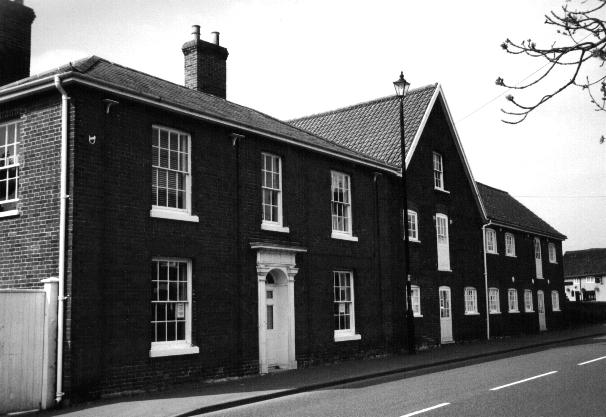
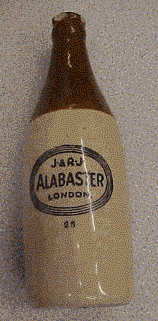 bottle that had been found at an old tip in Rainham,
Essex.
bottle that had been found at an old tip in Rainham,
Essex. 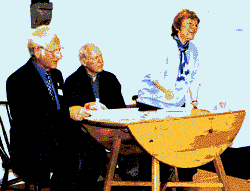
 We were welcomed at Worstead by Rev. Anthony Long and some of his parishioners. Father
Anthony gave us a very good guided tour around his church, showing us the screen in particular,
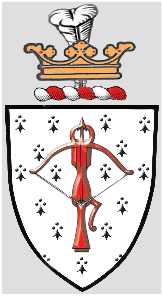
and the Arblaster/Alabaster arms which appear with others high up on the beams of the roof. We
were then provided with an excellent repast of tea and cake. Altogether, it was a wonderful
experience for us all.
We were welcomed at Worstead by Rev. Anthony Long and some of his parishioners. Father
Anthony gave us a very good guided tour around his church, showing us the screen in particular,
and the Arblaster/Alabaster arms which appear with others high up on the beams of the roof. We
were then provided with an excellent repast of tea and cake. Altogether, it was a wonderful
experience for us all.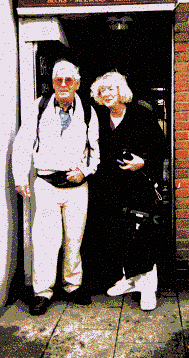 Since we were staying in a motel nearer Ipswich, it was most kind of those on the coach to stop and
pick us up...like two hitchhikers! Laraine pointed out all of the Alabaster highlights
along the way to Great Yarmouth and upon arriving, many of us chose to go on a
walking tour of the old part of the city. For us, that was the most memorable part of the
whole weekend, maybe even the most memorable day of the whole UK tour we had
been on for almost 20 days prior to the Gathering! The rain and wind made the tour
even more interesting for a while but when we approached the area of The Rows, that,
for us, was very emotional and I could see it on Moe's face. To be right there where his
father, Sydney Alabaster, lived and from where he immigrated to the United States was
the highlight of the day!
Since we were staying in a motel nearer Ipswich, it was most kind of those on the coach to stop and
pick us up...like two hitchhikers! Laraine pointed out all of the Alabaster highlights
along the way to Great Yarmouth and upon arriving, many of us chose to go on a
walking tour of the old part of the city. For us, that was the most memorable part of the
whole weekend, maybe even the most memorable day of the whole UK tour we had
been on for almost 20 days prior to the Gathering! The rain and wind made the tour
even more interesting for a while but when we approached the area of The Rows, that,
for us, was very emotional and I could see it on Moe's face. To be right there where his
father, Sydney Alabaster, lived and from where he immigrated to the United States was
the highlight of the day!