|
The Alabaster ChronicleThe Journal of the Alabaster Society
NUMBER TWENTY-SIX, AUTUMN 2006 |
|
The Alabaster ChronicleThe Journal of the Alabaster Society
NUMBER TWENTY-SIX, AUTUMN 2006 |
Contents
|
Editorialby Sheelagh Alabaster - March 2006Thank you to everyone who sent in contributions to this issue. There is a great deal about Old Father William and his Book again – the bug has bitten even the youngest of our readers. We also have for you inventions and patented ideas devised by Alabasters, details of building repairs carried out in 1579 in Hadleigh, news from members’ families, and an appreciation of the work of a Shoreditch Guardian and new Broom. I am determined we should make a regular feature of including a big group photo containing one very famous person and one very Alabaster. There must be hundreds out there. Please send them in. In the Secretary’s Pages this time Laraine reminds us that the next Gathering is starting to be planned for 2008. See page 2. We are delighted to report that our researcher in Italy discovered an impromptu Alabaster Gathering taking place earlier this year. See page... – no, I’m not going to do everything for you. Look for it yourself! To Contents |
News from Around the WorldCollected by Laraine HakeFirstly, a great big thank-you to Sheelagh for the splendid job she is making of editing the Chronicle. Remember, though, the Editor can only edit successfully if she is sent contributions -- so that is up to you! After the last Chronicle, I received a splendid phone call from John Henry Alabaster (WofW). He said he had received Chronicle 25, looked at page 10, and seen the photograph of 97 Squadron Observers in May 1945, including himself on the front row – yes, John Henry is the “Flying Officer Alabaster” whose photograph appeared in the book “Achieve Your Aim”. Since then, John has contacted the publishers of the book and has been able to get in touch with two of the crew he was with in 1945; the Flight Engineer, Jim Davies, who had stayed on in the RAF and became a Wing Commander, and the pilot, who was Canadian and was transferred to the Royal Canadian Air Force at the end of the war and is now living in Vancouver. John was amazed and delighted. Now – on a personal front, life is good! Our granddaughter Lily is two years old on 15th November and she has a sister (we think) due to be born next February, which is very exciting. I am still teaching three days a week, working a fourth day on SCITT, School Centred Initial Teacher Training, with one day off, which is great! A mere five years until retirement …what WILL I find to do with my time? Next – it is now almost two years since the last Alabaster Gathering. I have been given the impression that most of you would like to continue with the three year cycle…. that takes us to April 2008. So, make a note in the back of your diary now…and transfer it when you get the new one. We have decided to hold this one, the 8th Alabaster Gathering, in the Guildhall, Hadleigh, as we did in 1992, 1993 and 1996. I am sure that this will be a popular decision as it featured so much in the lives of our Hadleigh ancestors. Whilst on the subject of Gatherings, I attended the AGM of a club to which I belong in September (The New Chalet Club, should you be interested... Chalet School books … ).This AGM was held in St Botolph’s Church Hall, Bishopsgate Churchyard, less than five minutes’ walk from Liverpool Street Station, London. The main impetus for me attending this AGM was its venue and the fact that a tour of St Botolph’s was included in the programme for the day. Several Alabasters have had connections with this church: Robert Alabaster (IIA) m Elizabeth Simpson 1781 I really welcomed this opportunity, as you can imagine. So… it occurs to me that it would be an excellent venue for an additional Gathering – not to rival the one in Hadleigh, or even to be on similar lines, but interesting for many of us to meet up in London and see a different side to the lives of our Alabaster ancestors. What I have in mind would be a one day event, not a full-blown weekend like Hadleigh, possibly for sharing information rather than the more formal talks. Perhaps we could produce some maps of Alabaster haunts in the local area if anybody wanted to go for a stroll – even if London no longer looks quite the same now. So, over to you. To make it feasible, there would need to be at least 40 people interested in coming. If you are interested in a meeting at St Botolph’s, either for 2007 or 2009 onwards, let me know now. Then we can discuss the details. One of the other “Alabaster” occurrences in my life during the past 6 months include helping a friend, Lianne, with her own family history only to discover that the registration of her gt gt grandfather, William Joshua Honour Clews on 28th July 1860 in the sub-district of Holywell, Shoreditch, was made to James Alabaster, Registrar. James Alabaster was the part-founder of the printers and publishers, Alabaster Passmore & Sons Ltd and the gt grandfather of Shirley Rowe. Since the person who made the registration was Lianne’s gt gt gt grandmother, Emma Clews, and James was the first cousin of my gt gt grandfather, Thomas Alabaster [James was thus my first cousin 4 times removed] Lianne and I can actually state that members of our families spoke to each other 146 years ago! ...and another occurrence was at a boot sale at Banham Zoo, Norfolk. On one stall, the inscription on a bottle caught my eye…ALABASTER. This is clearly a bottle produced by the Alabasters who bought out Batey & Co, in 1882, but I would think it pre-dates the one in pictured in Chronicle 19. On the back it says: THIS BOTTLE
|
Now to share some of the letters I have received from you: John Henry Alabaster (WofW) Chigwell, 7th August 2006: John had included in his letter the various items sent to him by the museum following his enquiry. These included general details about George, the photograph and an obituary printed in The Journal of the South Wales Borderers and The Monmouthshire Regiment No.52, dated November 1957 as well as general details of the action in which the South Wales Borderers had been involved. ALABASTER, George ‘Ally’, 4977 Medals: Queen’s South Africa Medal clasps Paardeberg, Driefontein, Johannesburg, Diamond Hill, Wittebergen, Relief of Kimberley; King’s South Africa Medal clasps South Africa 1901, South Africa 1902; 1914/15 Star; British War Medal; Victory Medal; Long Service and Good Conduct Medal (AO443/Oct 1921 as WO1 Royal Welch Fusiliers #38037); Meritorious Service Medal (Geo V). Obituary I was naturally thrilled to receive so much information about one of our antecedents and very grateful to John for
having taken the time and interest to find out about this unknown, to him, Alabaster. I confess that I did not
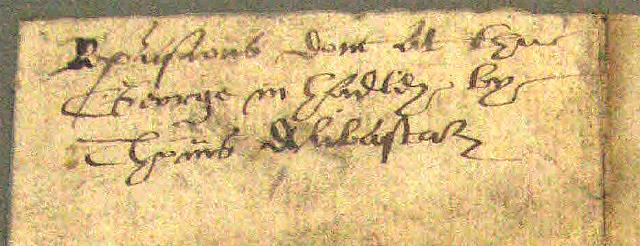
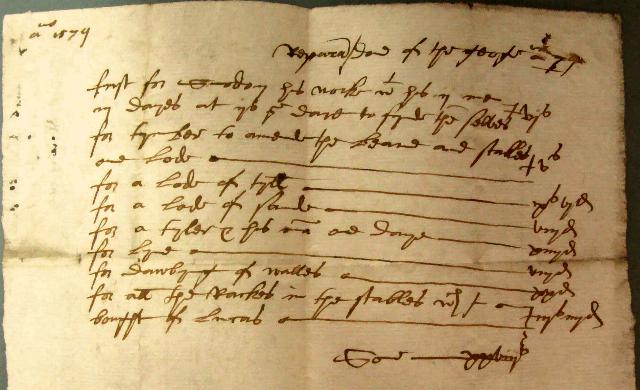
immediately check out specifically who George Alabaster was… in fact, I was fairly sure that I knew, but I was wrong. Geoff Mansfield, (IIA) Christchurch, New Zealand 5th October 2006: Congratulations to Geoff, Nicole and Kieran! To ContentsRepairs to ‘The George’ in Hadleighby Tony SpringallWe have known for several years, from Hadleigh records and a letter of 1600 from John Alabaster to his brother-in-law, that his father, Thomas Alabaster, leased ‘The George’ in Hadleigh from its copyhold owner, George Stoddard ‘of London’, during the last two decades of the 16th century. New information on this period of Alabaster custodianship, obscured in the PRO on-line catalogue over the years by the unusual spelling ‘Alibastar’ of the surname, has emerged in The National Archive at Kew. Dating from 1579, a document lists the repairs made to ‘The George’ by Thomas. The two images shown below are reproductions of this document and are followed by an attempt at its transcription (for which corrections and suggestions would be welcome). |
? ? 1579 |
|
|
The work carried out suggests that ‘The George’ was operating as an Inn by 1579 and, prior to the renovations, was in a bad state of repair. Perhaps Thomas Alabaster had recently leased the property and was getting it ‘shipshape’? The use of the first person in the last item suggests that the note was written by Thomas himself.
The ‘Lucas’ from whom Thomas bought the horse rack was probably John Lucas who paid his Subsidy in Hadleigh in 1543, 1552, 1568 and 1582. He is described as an ‘alien’ in 1543 and 1568 and as an ‘Alyaind’ and a ‘joyner’ in 1552. He was most likely the John Lucas who was buried in Hadleigh Church on 23rd June 1594.
The only candidate I can suggest for the incompletely transcribed surname in the first item is Edward Siday who married in Hadleigh on 22/7/1566 and paid taxes in the town in 1568 and 1582.
The document, which has the reference TNA, PRO, C4/49/64, provides no conclusive clues as to how it ended up in
The National Archives. However, the TNA website http://www.nationalarchives.gov.uk/ notes that C4 documents
‘comprise a miscellaneous collection of bills, answers, replications, rejoinders, commissions and depositions which have
become detached from their related documents.’
I have yet to find any related documents. Perhaps Thomas was involved in a court case concerned with the upkeep of
the property?
Thank you so much for the article and photos. How exciting to find that. I especially like the Dawbyng of walles. I could have found him a gang of comprehensive school kids to do that bit of the schedule of works for absolutely nothing. Ed.
A Tribute to Elsie AlabasterThe funeral of Elsie Alabaster (IIIB), the last survivor of the five children of James Alabaster and Florence (known as Mitti), was held in Luton/Dunstable on Friday, 21st April 2006. Martin Alabaster, her only nephew and next of kin, read the following tribute: Of course we all have different memories of Elsie and I am very conscious that my own - of a loving, kind and
independent aunt - only cover one point of view and the more recent years of her life. Elsie was the middle child of
five and the last to be born in London before Mitti and Pop moved their family to Dunstable. |
News from ArgentinaJorge Alabaster enjoyed seeing the photos of his relatives we printed in the last issue. He tells me that his maternal grandfather also had a photography studio. Jorge is now 73, a retired telecommunications specialist of Buenos Aires and writes that he has the following family: His wife, Maria Cristina Alonso, 61, geography teacher His son:Eduardo Enrique Alabaster, 28,single, architect. Jorge’s sister is Clyde Ana Maria Alabaster who is 70. Another sister Maria de las Marcedes Alabaster, 61, is married to Alberto Dominguez; When he was young Jorge lived in La Plata until his father died at the age of 47 – Jorge was 11. The family then moved to San Martin Peia de Buenos Aires, and later to San Andres, a town with a lot of English people involved in the construction of the Retiro-Jose Leon Suarex railway. His earliest memory was visiting the HMS Ajax and HMS Exeter before the Battle of the River Plate, when the Graf Spee was sunk. He says his father was working at the La Plata YPF distillery and was the official interpreter, having a great deal of international contact. He spoke English fluently and visited the British ships with an officer, and was given a commemorative medal from the Ajax as a souvenir. The Battle of the River Plate was in 1939, the first major naval battle of World War Two. Ships from the Royal Navy’s South American division took on Germany’s pocket battleship Graf Spee which had successfully been attacking merchant shipping in the South Atlantic. The Ajax, the Exeter, the Cumberland and the Achilles formed this division. The commander reckoned the Graf Spee would attack shipping lines from Argentina and Brazil en route to the UK. Three neutral countries allowed ships to use harbour facilities, Argentina, Uruguay and Brazil. He stationed his four cruisers in the River Plate in Uruguay. To ContentsGo West, Young ManDave West writes from Cambridge:I believe I may have a part of the puzzle regarding Walter Alabaster West mentioned in Ivor Smith’s article on Branch
IV of the Alabaster family. It is all on this website, of course! RW To ContentsLatest Members of the Alabaster Societyfrom Laraine HakeSince Chronicle No. 25 went to press, we have had six new members join the Society, numbers 180-185. I am taking this opportunity of introducing them to the rest of their Alabaster Society family members. They are: Justin More (IIA), Stephen Street (WofW), Carol Osborne (IIA), Christopher Chambers (IIB), Alan Alabaster (IIIA) and Denise Moreton (IIIA). I have had some gentle amusement in working out how they relate to other, existing members. Taking a branch at a time…IIA: Justin lives in London. He has been tracing his family tree for some time and came upon the Alabaster Society
website and contacted me through that. He is the grandson of Martha Clara Alabaster (1864-1952), who was herself
the daughter of Robert George Alabaster 1830-1915), son of James the publican and Mary Ann Weston. In fact, it was
two of Martha Clara’s brothers, John and Robert James who bought Batey & Co in 1882 – see letters page. Justin has
said that he may still have some family papers relating to Batey & Co which he will endeavour to sift through when
he has the time. Carol lives near Huntingdon. Carol and I came in contact through Genes Reunited. Her mother, Mary is the daughter
of Ellen Elizabeth Alabaster (b.1884). Ellen was the daughter of Edwin Alabaster (1855-1932), son of Thomas
Alabaster and Sarah Letitia Lawrence. Carol has given the society several Alabaster Memorial Cards from her family,
dating back to the 1930s. What do you mean you are getting confused? Keep up, I will be asking questions later… OK, perhaps a diagram might help – Unfortunately, after much effort, I found that the tree was far too big to fit on the page, so I guess you will have to give it a go yourself…… At the top, place Robert Alabaster (1757-1821) – he was born in Baylham, Suffolk, not so many miles from Hadleigh where the family had been until a century earlier, but moved to Shoreditch in London by 1783 when there is a record of him paying land taxes on Tenter Ground in Shoreditch, having married Elizabeth Simpson at St Botolphs, Bishopsgate in 1781. Robert was a straw hat maker – in our Alabaster tree we define him as being at the start of the division of the branches of the family. He is the first of Branch IIA. On the next line put James (1794-1849) and Charles Henry (1797-1861), two of the ten children of Robert and Elizabeth. We often refer to James as “James the publican” because he had the Market House, Finsbury Market for several years, at least from 1824 to 1848. Charles Henry moved to Bethnal Green and was in the business of manufacturing hats, like his father before him. The next line will show the three sons of James and his first wife, Mary Ann Weston. They were (1) James (1826-1892), gt grandfather of Shirley Rowe, (2) Edward (1828-1912) gt grandfather of Peter Douglas Arthur Alabaster (3) Robert George (1830-1915), gt grandfather of Justin More – our three mutual third cousins!Still on the same line, we have Thomas (1828-1889) one of the twelve children of Charles Henry and his wife, Sarah Mead. Thomas was a carpenter and joiner, marrying Sarah Letitia Lawrence in 1852 in Bethnal Green. On the next line, we have three of the children of Thomas and Sarah Letita. They are (1) Thomas (1853-1924) gt grandfather of Judith Cash, Sylvia Good, Barry Oram, Janine Howle, Michael Oram and myself, Laraine Hake, (2) Edwin (1855-1932), gt grandfather of Carol Osborne, (3) Sarah Alabaster (1859-1940) gt grandmother of Tony Springall, another eight mutual third cousins. Did that make it any easier…or would it be better not to ask? IIB: Christopher now spends most of his time in Cyprus. He and I were originally in correspondence in July 2000 when
Chris contacted me through East of London Family History Society. He is actually an Alabaster connection by a
convoluted relationship between Plummers, Pasqualls and Alabasters – even trying to draw this one out made my
eyes water, but here goes……in 1878, Henry Alabaster (1849-1890), the son of George Alabaster (1816-1863) and
Susannah Kench Rogers, married Annie Plummer (that’s the easy bit). Annie was the daughter of John Henry Plummer
whose sister, Nancy Plummer, had married Henry Pasquall in 1866, so Nancy Pasquall, nee Plummer, was Annie’s
aunt. - Incidentally, William Alabaster IIB (1761-1836), grandfather of George, and Robert Alabaster IIA (1757-1821), were brothers -- WofW (William of Woodford Branch): Stephen lives in Rochford, Essex. He is actually the grandson of John Henry Alabaster whose photograph appeared in Chronicle No.25 as part of 97 Squadron Observers – see Letters page. Stephen and I had been in contact through Genes Reunited previously but he was spurred on to join the Society by hearing his grandfather’s tale of getting in touch with his ex-RAF crew when they met up at Stephen’s brother’s wedding in June. Because Stephen is quite young by the standards of Alabaster Society members, being born in 1971, finding Stephen’s closest relatives in the Society, of the same generation (he already knew about his grandfather) meant I had to go back quite a way to Stephen’s gt gt grandfather, Henry Alabaster (1845-1910). Henry was the son of Thomas Alabaster (1808-1859) and Susannah Lingley – in fact, this Thomas was himself the son of the William Alabaster who was entered in the parish register of St Pancras as “William Alabaster of Woodford, Essex” when he married Mary Plummer in 1806; as we had not been able to trace any Alabaster in Woodford at that time, we ended up naming the whole branch after him….although DNA tests showed that they are definitely of the same stock as all the other branches and I am fairly confident that they are actually descended from Branch I, but I digress - Henry was the son of Thomas Alabaster (1808-1859) and Susannah Lingley. Henry’s older brother, George Alabaster (1840-1897) was the gt gt grandfather of Malcolm Alabaster, Heidi Nevin, Christopher Alabaster and Jean Clifton so they all share Thomas and Susannah as gt gt gt grandparents making them 4th cousins to each other. IIIA: Denise lives in Yardley, Birmingham. She is another member with whom I first had contact through the website, Genes Reunited. Denise is the gt granddaughter of Henrietta Florence Alabaster (b. 1870) who was the youngest of the twelve children of Robert Hedges Alabaster (1830-1898) and Sarah Ann Brazier, six boys and six girls. The closest relative of the same generation I could find for Denise is George David Alabaster whose gt grandfather, Roger George Alabaster (1868-1939) was the youngest of Henrietta’s six brothers. Denise and George David share Robert Hedges as their gt gt grandfather so they, too, are 3rd cousins. Alan lives in Canada. Alan’s claim to fame (or at least one of them) is that, whilst being an Alabaster by male descent, his grandfather decided to change his surname to Crawford – interestingly, changing their surname seems to have been a quirk amongst various members of the Alabaster family on occasion – so Alan can use either. Once again, Alan and I did have some communication a few years ago. I am pleased that he has now decided to join our happy throng. Alan is Branch IIIA, like Denise, but he is descended from the older brother of Robert Hedges Alabaster, that is Walter Goddard Alabaster (1827-1888). Alan’s gt grandfather was Walter John Alabaster (1854-1905). Other members of the same generation are Janet Gillian LeClair and her brothers John Alabaster, Rob Alabaster and sister Susan Alabaster. Like Alan, these four are gt grandchildren of Walter John, so they are Alan’s second cousins. James Christopher Alabaster (Jim) is the gt grandson of William Henry Alabaster (1849-1933), older brother of Walter John. William Henry was also gt grandfather to Susan Maydom and Robert Clifford Alabaster. Another brother of Walter John, Albert Alfred Alabaster (1856-1930) was the gt grandfather of Bryon Alabaster of Canberra, whilst the youngest son of the eleven children of Walter Goddard and Louisa Alabaster (nee Patten), Ernest Thomas Alabaster (1870-1919) was the gt grandfather of Lynn Alabaster who also now lives in Australia. Thus Alan, Janet, John, Rob, Susan Alabaster, Susan Maydom, Robert Clifford, Bryon and Lynn share gt gt grandfather, Walter Goddard Alabaster and are mutual 3rd cousins. Interestingly, this group of cousins are possibly the furthest flung – Alan is in Canada, Janet and Susan are in France, John is in Hong Kong, Bryon and Lynn are in Australia. Having worked through this little lot, I think I will regard new members in a different light from now on. Should anybody who has read this far (besides deserving a medal) wish to contact any other member of the Society, do feel free to write to me and I will be very pleased to pass it on so that you can communicate direct in future. To Contents |
Edward -- James -- Robert George
|
Dr William AlabasterBiographyEmily writes proudly at the end of her composition: I am distantly related to William Alabaster. A biography that Emily wrote for her homework about a special person, and she chose William Alabaster. Hope you will be able to read it, as she wrote it in pencil and of course that does not print out quite so clearly. Jean thought you would like to see her daughter's handiwork. Fortunately we had reference books handy and they also looked on the internet for more details. The teacher has not been able to mark their efforts yet but when we hear we will let you know how we got on. Love from Millie and George NB Emily, the biography on the following page is NOT what you wrote, but I hope you enjoy reading it. Ed. Some information (with added sound effects and special emphasis for those who like adventurous stuff) lifted and embroidered from Francis J Bremer’s entry in the Oxford Dictionary of National Biography :William Alabaster 1568 – 1640, born in Hadleigh, son of Roger Alabaster and Bridget Winthrop. After Westminster (sound of small boys playing conkers and singing in the choir ) and then Trinity College, Cambridge, where his Latin tragedy Roxana was thought to have been performed in 1587/8 after a pirated edition had appeared ( A lady fainted. Rustle of skirts. Bump) Alabaster worked on his epic poem, Elisaeis, in praise of Queen Elizabeth, and praised in its turn, though it remained incomplete, by Spenser (sound of specially good poet in sparkly doublet reading Fairy Queen) in 1591. He joined the Earl of Essex on the expedition to Cadiz (probably waves and storm here for a bit, and All Hands on Deck), meeting with Catholics in the captured city there. Back in England, he had a living in Cornwall (more waves and Beach Boys songs), and while in London he met a Roman Catholic priest living under house arrest, Father Tom Wright. It was hoped the brilliant Alabaster would convert Wright, but the opposite happened. Lots of plots. He was placed under confinement and many important figures attempted to talk him round. This failed, and he “took advantage of loose security to escape the Clink in Southwark.” Possibly some galloping and certainly lots of cloaks flapping. According to the Journals of aldermen of London, a warrant describes him as ’a tall young man about the age of thirty, sallow coloured, long-visadged, lean-faced, black-haired, and speaketh somewhat thick’. He took refuge in Rome, later travelling to Spain (maybe a bullfight scenario ole), and was then captured on his wayback to England, was involved in the trial against Essex in 1601, was pardoned by James I, but re-arrested in 1604, and released again in 1607, when he left for Europe, here publishing OUR BOOK, a work of cabbalistic divinity that was considered by some to be heretical. Lots more plots ensued. When he came back to England in1611, he eventually made peace with the Church of England and was given a living at Therfield, Hertfordshire, preached to the King, got married to the widow Kathryn Fludd. Romantic music.. He was interested in the work of John Dee and others, where the occult , medicine, cabbalism (no, not cannibalism) & alchemy blended. Sparks, bubble, bubble, cauldrons etc. He was praised for his Latin verse; his style regarded as a forerunner of
mannerist or metaphysical expression. His modern reputation is based mostly on his vernacular religious sonnets,
which only became widely known incomparatively recent years. Samuel Hartlib wrote of him in 1640, the year he died, ‘…a universall scholar of a stupendous memory… an excellent Latinist… Poet. A great Linguist. The best Hebrician in England. Though hee bee Antick and Phantastical in some things in his Caballistic writings yet even in that booke there are many .... excellent notions.’ To Contents |
William`s BookWe can see it, we can read it, we just can’t understand it - yetby Sheelagh AlabasterWith a list of libraries that Tony Springall gave me I wrote to places I thought might be able to help us understand our book. The libraries with first edition copies of William's book are as follows:-
I wrote to each of them: re William Alabaster`s apparatus in revelationem jesu christi publ.Antwerp 1607, sending
them a copy of Tony’s article that we included in our last issue.
We were also sent a copy of the entry in the Oxford Dictionary of National Biography, in Association with the British Academy, ed Matthew And Harrison, Oxford University Press volume 1,p 554-555 which has additional references in its Sources:
And a very nice reply from Dublin: First, let me congratulate you on acquiring such a rare and fascinating text. I hope the Alabaster Society is deriving great pleasure from it. Secondly, I must confess that, although I am finishing a Ph.D. which includes Alabaster in its scope, I can give very little advice on this book. The librarians of Trinity know of my interest in Alabaster because I am working on religious sonnet sequences of the later sixteenth-century, and Alabaster seems to have written some of his sonnets while in residence in the College: you probably know Dana Sutton's Unpublished Works by William Alabaster (1568-1640) (Salzburg ; Oxford : University of Salzburg, 1997), which covers that period in his life. However, although a full-length study of his life and work is something I hope to embark on in the next few years, those few years will have to be employed in the study of Hebrew - amongst other things - before I am qualified to deal with his later writings, such as this one. I realise that you would like some more immediate advice on the text, but regret to say that - despite enquiries - I cannot find anyone currently working on the book. I am sure you are aware of the scholars working on his sonnets (if not, please allow me to forward you a list). I will continue to enquire, however, and will pass on any information I discover. I would be glad if I could advise you on other aspects of Alabaster's writing. Please do not hesitate to contact me if you have any questions. And perhaps, when I have made some strides with my Hebrew studies, you will allow me to see your copy of the Apparatus. With all best wishes, Sheelagh wrote: Deirdre replied: I hope this proves of interest. He really is the most fascinating character, as well as being a wonderful writer. Are you descended from him? Lucky you. All the best, I then wrote to Professor Dana Sutton, following the references from both Dublin and from the Lambeth Palace Library, and received this reply: Dear Ms. Alabaster: My Alabaster stuff can be read online in The Philological Museum, if you want to take a look at it. The URL is www.philological.bham.ac.uk/ Sheelagh wrote: From: "Dana F. Sutton": Now, who is going to take it on from here?I wrote in July to Dr Francis Bremer, who did the Dictionary of Biography
entry, but no reply there. LinksLinks in connection with William's Book: perhaps we should try advertising the possible similarities between it and the Da Vinci Code.................or have I got that completely wrong?! Laraine. A reminder to mention the web address www.alabaster.org.uk in the Chronicle. Please see http://www.philological.bham.ac.uk for Dana Sutton`s work on William Alabaster. To ContentsWhile we are giving website links… Pathé News OnlineUntil 1970 cinemas all over Britain showed Pathé newsreels. Now you can view the entire collection, over 3500 hours, online at http://www.britishpathe.com It is necessary to register, but whilst there is a charge for high-resolution copies of the films you can view low resolution versions free of charge. Almost all are in black and white, and the very earliest footage is silent. The earliest films date from 1896! Pathé display a Top Twenty on their site - the most popular when we checked was a film of the Titanic, but an early favourite of ours is the funeral of Queen Victoria in 1901. To Contents |
|
 Elsie did tell me that
Alan, my father, was born soon after her 5th birthday and so his arrival
coincided with her being sent to school for the first time and she thought at first
that this was because she was no longer wanted at home! She was approaching
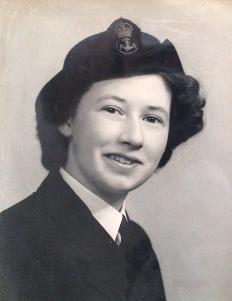
15 when the war started and she joined the WRNS as soon as she was old
enough and served for several years, particularly at HMS President alongside
[her sister] Hazel, gaining her commission. Here she made many friends. At the
end of the war, aged about 23, she returned to civilian life in Dunstable and
started what was to turn out to be almost 30 years working at the local
engineering firm of Bagshaws. Most significantly, she met - at the next desk -
Phyllis, her greatest friend. They were so close in the office that Phyllis would
prod Elsie with a ruler to get her attention. Their careers ran side by side and
they ended up as heads of their respective sections. And of that time, Phyllis
has said that Elsie was the best friend and confidante she could possibly have
had and that they never exchanged a cross word, ever. Also over this time Elsie
was a great support to her older sister. Ruby was often not in the best of health
and had been deaf from quite a young age. So she greatly benefited from the
support of Elsie who would always accompany her on trips out and to social
events. Such was the way of Elsie's life for many years and her strength and good nature were always her prominent
characteristics.
Elsie did tell me that
Alan, my father, was born soon after her 5th birthday and so his arrival
coincided with her being sent to school for the first time and she thought at first
that this was because she was no longer wanted at home! She was approaching
15 when the war started and she joined the WRNS as soon as she was old
enough and served for several years, particularly at HMS President alongside
[her sister] Hazel, gaining her commission. Here she made many friends. At the
end of the war, aged about 23, she returned to civilian life in Dunstable and
started what was to turn out to be almost 30 years working at the local
engineering firm of Bagshaws. Most significantly, she met - at the next desk -
Phyllis, her greatest friend. They were so close in the office that Phyllis would
prod Elsie with a ruler to get her attention. Their careers ran side by side and
they ended up as heads of their respective sections. And of that time, Phyllis
has said that Elsie was the best friend and confidante she could possibly have
had and that they never exchanged a cross word, ever. Also over this time Elsie
was a great support to her older sister. Ruby was often not in the best of health
and had been deaf from quite a young age. So she greatly benefited from the
support of Elsie who would always accompany her on trips out and to social
events. Such was the way of Elsie's life for many years and her strength and good nature were always her prominent
characteristics. 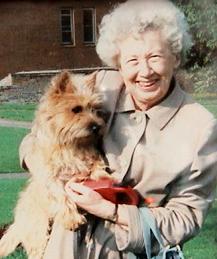 With Hazel married and her parents getting older, Elsie increasingly became the pillar which held
the family up and this was certainly true right through until the early 1970s when
everything changed. In 1972 [her brother] Alan was killed in an accident and Pop,
his and Elsie's father died only a few weeks later. Bagshaw`s closed and Elsie was
made redundant, and then in 1978, Hazel and Mitti died in close succession only
to be followed by Ruby the following year. And so, the final phase of her life -
some 26 years’ worth - were spent living on her own but certainly not miserably.
When she retired she became busy with craft classes, lunch clubs, the President
Association and with her two great Cairn terrier companions: first Jody and more
recently Rory (pictured right). The dogs kept her active, walking through town in all
weathers and making many new friends right up until a few weeks ago. And, of
course, with Hazel gone, it was Elsie who provided the support - to her
brother-in-law Fred as he grew older and struggled to look after himself in
Bullpond Lane. And what of my own personal memories? Well, as a child I loved
Christmases at Houghton Road and Elsie was the one who was not only the most
fun but she was also the best cook. Her cooking was extraordinary for its time: hand-made Apfelstrudel, exotic
pastries and beautifully decorated cakes. And as she got older and I visited her with my two children, Hugh & Maddy,
we were always warmly welcomed and she knew just how to look after and entertain them. In addition, she never
missed a birthday and always found perfectly judged presents for us all. And to the end, despite increasingly
frustrating deafness, she remained sharp, well-informed and extremely pragmatic about everything. So Elsie's story is
one of great energy and initiative but with her own ambitions almost always pushed into second place to the needs of
others. Elsie was always caring, supportive, determined and independent. We will miss her.
With Hazel married and her parents getting older, Elsie increasingly became the pillar which held
the family up and this was certainly true right through until the early 1970s when
everything changed. In 1972 [her brother] Alan was killed in an accident and Pop,
his and Elsie's father died only a few weeks later. Bagshaw`s closed and Elsie was
made redundant, and then in 1978, Hazel and Mitti died in close succession only
to be followed by Ruby the following year. And so, the final phase of her life -
some 26 years’ worth - were spent living on her own but certainly not miserably.
When she retired she became busy with craft classes, lunch clubs, the President
Association and with her two great Cairn terrier companions: first Jody and more
recently Rory (pictured right). The dogs kept her active, walking through town in all
weathers and making many new friends right up until a few weeks ago. And, of
course, with Hazel gone, it was Elsie who provided the support - to her
brother-in-law Fred as he grew older and struggled to look after himself in
Bullpond Lane. And what of my own personal memories? Well, as a child I loved
Christmases at Houghton Road and Elsie was the one who was not only the most
fun but she was also the best cook. Her cooking was extraordinary for its time: hand-made Apfelstrudel, exotic
pastries and beautifully decorated cakes. And as she got older and I visited her with my two children, Hugh & Maddy,
we were always warmly welcomed and she knew just how to look after and entertain them. In addition, she never
missed a birthday and always found perfectly judged presents for us all. And to the end, despite increasingly
frustrating deafness, she remained sharp, well-informed and extremely pragmatic about everything. So Elsie's story is
one of great energy and initiative but with her own ambitions almost always pushed into second place to the needs of
others. Elsie was always caring, supportive, determined and independent. We will miss her.
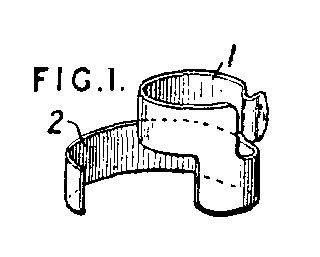 One of the earlier records is of a Herbert Alabaster who in 1906,
together with one Frederick Knight, submitted an ingenious design
for a holder which would automatically adjust to accommodate
candles of any size.
One of the earlier records is of a Herbert Alabaster who in 1906,
together with one Frederick Knight, submitted an ingenious design
for a holder which would automatically adjust to accommodate
candles of any size.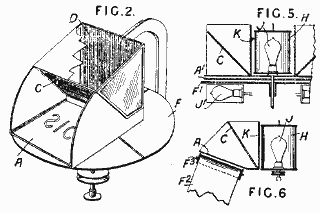 We are now so used to
infinitely-variable coloured displays controlled electronically by
micro-switches, that it seems all the more remarkable the extent to
which people attempted to achieve such variety mechanically.
We are now so used to
infinitely-variable coloured displays controlled electronically by
micro-switches, that it seems all the more remarkable the extent to
which people attempted to achieve such variety mechanically.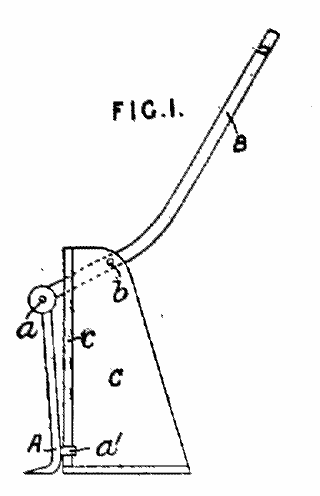 The lamps J<1> may have
lightdiffusing shades. A number of the reflecting-surfaces c and
their accessory parts may be grouped about a single lamp J. The
coloured disk F<1> may be replaced by coloured bands F<2>, Fig. 6,
on rollers F<3>, placed behind a stencil A. The reflector C, Fig. 2,
may comprise strips of ordinary silvered-glass surface, or parallel
distanced strips of metal; or it may be made of finely-grooved
glass, silvered, with the silver removed from between each pair of
grooves. The advertisement may be transmitted through the plate
C, and the background may be reflected.
The lamps J<1> may have
lightdiffusing shades. A number of the reflecting-surfaces c and
their accessory parts may be grouped about a single lamp J. The
coloured disk F<1> may be replaced by coloured bands F<2>, Fig. 6,
on rollers F<3>, placed behind a stencil A. The reflector C, Fig. 2,
may comprise strips of ordinary silvered-glass surface, or parallel
distanced strips of metal; or it may be made of finely-grooved
glass, silvered, with the silver removed from between each pair of
grooves. The advertisement may be transmitted through the plate
C, and the background may be reflected. 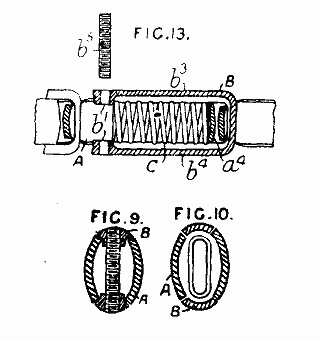 In 1912, my great-grandfather, Arthur, co-founder of the
Birmingham firm of Alabaster and Wilson, goldsmiths, submitted a
cunning design for expanding bracelets. How could he have
foreseen that, ninety years on, the sons and daughters of Albion
would become the fattest people in Europe and in the direst need
of every possible expanding device, from trousers to jewellery?
Interestingly, his Victorian upbringing is evident in the pains he
took in designing the meeting edges of the members so as "to
prevent side-play between the members".
In 1912, my great-grandfather, Arthur, co-founder of the
Birmingham firm of Alabaster and Wilson, goldsmiths, submitted a
cunning design for expanding bracelets. How could he have
foreseen that, ninety years on, the sons and daughters of Albion
would become the fattest people in Europe and in the direst need
of every possible expanding device, from trousers to jewellery?
Interestingly, his Victorian upbringing is evident in the pains he
took in designing the meeting edges of the members so as "to
prevent side-play between the members". 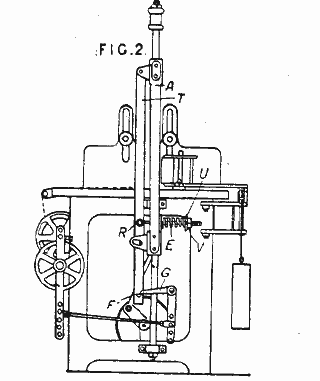 In 1920, Sidney Herbert again, together with William Sandell,
patented improvements to a reciprocating sawing machine such as
the makers of that Hollywood Classic, "The Texas Chainsaw
Massacre", would have given serious money to have heard about.
Who knows to what depths that cheery tale might have
plummetted had such sophistication been at the disposal of the
film's principal actors?
In 1920, Sidney Herbert again, together with William Sandell,
patented improvements to a reciprocating sawing machine such as
the makers of that Hollywood Classic, "The Texas Chainsaw
Massacre", would have given serious money to have heard about.
Who knows to what depths that cheery tale might have
plummetted had such sophistication been at the disposal of the
film's principal actors? 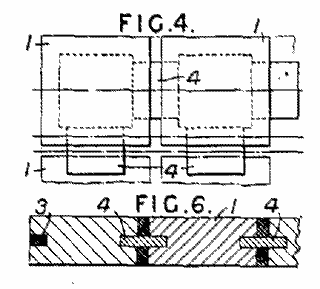 In 1931, the London firm of printers, Alabaster Passmore and Sons
patented an improved system to support a surface to receive print,
consisting of carefully-arranged wooden blocks, the aim of which
would seem to be to ensure a more even pressure was applied
over the whole surface.
In 1931, the London firm of printers, Alabaster Passmore and Sons
patented an improved system to support a surface to receive print,
consisting of carefully-arranged wooden blocks, the aim of which
would seem to be to ensure a more even pressure was applied
over the whole surface. 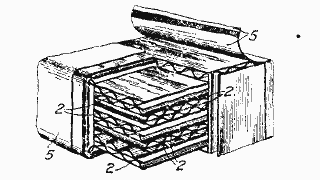 In 1936, Geoffrey Hubert Alabaster joined forces with John Aubanel
in patenting a block built up of layers of corrugated paper
interleaved with metal foil to act as an insulation for heat and
sound. This was to be encased in a waterproof and fire-resistant
material. It sounds rather more eco-friendly than some of the
insulating panels and blocks used in present-day construction.
In 1936, Geoffrey Hubert Alabaster joined forces with John Aubanel
in patenting a block built up of layers of corrugated paper
interleaved with metal foil to act as an insulation for heat and
sound. This was to be encased in a waterproof and fire-resistant
material. It sounds rather more eco-friendly than some of the
insulating panels and blocks used in present-day construction. 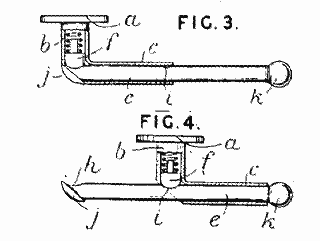 In 1939, a veteran of the First World War, my grandfather, Arthur
Stanley Alabaster, was making sure we'd at least be properly
turned out in the event that the Wehrmacht decided to pay a visit.
His improved collar-stud design would keep our boys' shirts looking
smart. This stud would also be useful for attaching clean
shirt-fronts. When Churchill later promised to "fight them on the
beaches", the invading forces could be certain of an elegant
resistance.
In 1939, a veteran of the First World War, my grandfather, Arthur
Stanley Alabaster, was making sure we'd at least be properly
turned out in the event that the Wehrmacht decided to pay a visit.
His improved collar-stud design would keep our boys' shirts looking
smart. This stud would also be useful for attaching clean
shirt-fronts. When Churchill later promised to "fight them on the
beaches", the invading forces could be certain of an elegant
resistance. 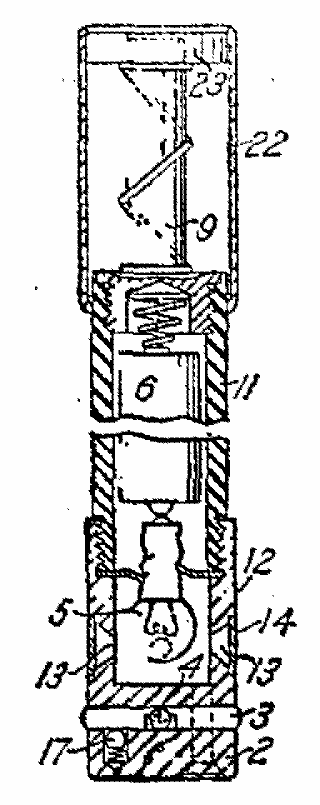 This brings me to the latest item which I have to hand, namely "a
device for setting the distance of a workpiece from a rotatable
member", submitted for patent in 1959 by Clifford Alabaster. The
device incorporated an electrical circuit which would be completed
upon achievement of the selected distance and indicated by a
light. This would have many important applications in the
workshop and possibly on the dance-floor, making for great
precision in the more energetic Latin routines perhaps?
This brings me to the latest item which I have to hand, namely "a
device for setting the distance of a workpiece from a rotatable
member", submitted for patent in 1959 by Clifford Alabaster. The
device incorporated an electrical circuit which would be completed
upon achievement of the selected distance and indicated by a
light. This would have many important applications in the
workshop and possibly on the dance-floor, making for great
precision in the more energetic Latin routines perhaps?