An Alabaster Family in Bethnal Green
in the Latter Half of the Nineteenth Century.
by Laraine Hake
 The character of an area such
as Bethnal Green, where the
family of Thomas and Cordelia
Alabaster lived until 1883,
must have changed
dramatically as the nineteenth
century grew older. Thomas's
grandparents, Charles Henry
and Sarah Alabaster, nee
Mead, had moved to Bethnal
Green from Shoreditch in about
1830. Sarah's father, Thomas
Blewett Mead had died in 1830
in Fyfield, Essex, leaving "unto
my daughter Sarah Alabaster
all those my five freehold
messuages Nos 10, 11, 12, 13
and 14 Coventry street,
Bethnal Green ............... and
also all those my three
messuages Nos. 5, 6, and 7 in
Cross Street, Three Colt Lane,
Bethnal Green..........". An
indenture dated as early as 15th August 1809, shows Thomas Blewett Mead involved in the lease and release of
property bounded by Abington Street, Parliament Street and Bethnal Green Road.1 Judging by maps of that period,
this part of Bethnal Green must have been well to the east of the metropolis of London, bordering on open
countryside. The character of an area such
as Bethnal Green, where the
family of Thomas and Cordelia
Alabaster lived until 1883,
must have changed
dramatically as the nineteenth
century grew older. Thomas's
grandparents, Charles Henry
and Sarah Alabaster, nee
Mead, had moved to Bethnal
Green from Shoreditch in about
1830. Sarah's father, Thomas
Blewett Mead had died in 1830
in Fyfield, Essex, leaving "unto
my daughter Sarah Alabaster
all those my five freehold
messuages Nos 10, 11, 12, 13
and 14 Coventry street,
Bethnal Green ............... and
also all those my three
messuages Nos. 5, 6, and 7 in
Cross Street, Three Colt Lane,
Bethnal Green..........". An
indenture dated as early as 15th August 1809, shows Thomas Blewett Mead involved in the lease and release of
property bounded by Abington Street, Parliament Street and Bethnal Green Road.1 Judging by maps of that period,
this part of Bethnal Green must have been well to the east of the metropolis of London, bordering on open
countryside.
Descendants of Thomas Blewett Mead
Thomas Blewett MEAD b 1773, d 9 February 1830
+ Sarah LEE b 1774, d 22 December 1845
|____Sarah MEAD b 2 March 1798 Christopher Alley, Shoreditch, d November 1857
|.........+ Charles Henry ALABASTER b 3 January 1797 King Street, Shoreditch,
| | d 18 October 1861 14 Coventry street, Bethnal Green
|.........|____Mary Ann ALABASTER b 26 June 1824 Clifton Street, Shoreditch
|.........|.........+ William James MANSFIELD
|.........|..................Geoffrey MANSFIELD
|.........|..................Margaret EVANS (nee Mansfield)
|.........|..................Brian MANSFIELD
|.........|..................Andrew CLARK
|.........|____Thomas ALABASTER b 7 February 1828 Shoreditch, d 11 October 1889 19 Paradise Row, Bethnal Green
|.........|.........+ Sarah Letitia LAWRENCE b 24 March 1823 Helions Bumpstead, Essex,
| | | d 20 March 1868 10 Coventry Street, Bethnal Green
|.........|.........|____Thomas ALABASTER b17 June 1853 6 Bartholomew Place, Bethnal Green,
| | | d 12 December 1924 208 Fleeming Road, Walthamstow, E17
|.........|.........|.........+ Cordelia Victoria JOLLY b 3 October 1852 22 Bedford Street, Stepney,
| | | d 17 August 1939 208 Fleeming Road, Walthamstow
|.........|.........|....................Alfred ORAM
|.........|.........|....................Leslie ORAM
|.........|.........|....................Sylvia GOOD (nee Chapman)
|.........|.........|....................Barry ORAM
|.........|.........|....................Michael ORAM
|.........|.........|....................Laraine HAKE (nee Oram)
|.........|.........|....................Janine HOWLE (nee Oram)
|.........|.........|____Edwin ALABASTER b 31 July 1855 5 Cross Street, Bethnal Green, d June 1932 West Ham
|.........|.........|____Catherine ALABASTER b June 1857 Bethnal Green
|.........|.........|____Sarah ALABASTER b 28 June 1859 10 Cross Street, Bethnal Green, d 12 April 1940
|.........|..................+ William Lake RICHARDS b 1856
|.........|..............................Anthony SPRINGALL
|.........|____Robert ALABASTER b 28 July 1835 Bethnal Green, d 12 December 1864
|.........|........+Harriet HARRIS b 1828, d 17 Frbruary 1908 Hackney
|.........|..................Norman ALABASTER
|.........|..................Philip ALABASTER
|.........|..................Beryl NEUMANN (nee Young)
|.........|____others
|____others
Thomas's father, Thomas, was born in Shoreditch in 1827, so must have moved to 14 Coventry Street, Bethnal Green
with his parents when he was about three years old. He married Sarah Letitia Lawrence in 1852 in St Philips Church,
Bethnal Green. Sarah was a real country girl, having been born in Helions Bumpstead, on the Essex/Suffolk border in
1823 where her father farmed. Her family had moved to Bethnal Green in the late 1830s where her father became a
Hackney Carriage Driver. In 1852, at the time of her marriage, she was living in 10 Cross Street. Within this small area
of streets, Thomas and Sarah Letitia had and raised their family. The 1861 census shows Thomas and Sarah Letitia
with their family, including Thomas aged 7, later to marry Cordelia, at 10 Coventry Street. At numbers 13 and 14
Coventry Street lived other Alabasters, including Charles Henry, now a widower aged 64 with three unmarried
daughters at number 14, and his son Charles with his wife and various nephews and nieces at number 13.
The 1871 census finds Thomas, aged 17, a dock messenger, living with his mother's brother, George Lawrence in
Wellington Row, Bethnal Green, his mother, Sarah Letitia having died in 1868. 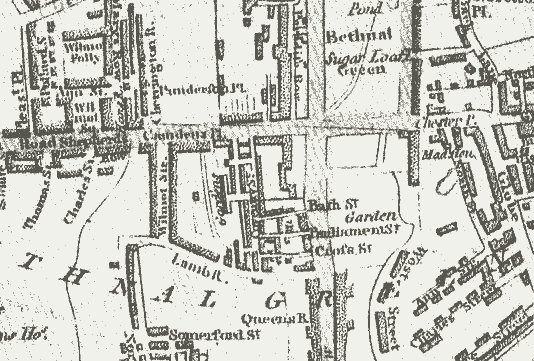 He married Cordelia Victoria Jolly,
daughter of George Jolly, an
ironmonger, and Jane nee
Davidson, at Hackney Parish
Church on 11th May 1873. He married Cordelia Victoria Jolly,
daughter of George Jolly, an
ironmonger, and Jane nee
Davidson, at Hackney Parish
Church on 11th May 1873.
Left: Bethnal Green 1819
Thomas and Cordelia lived at
various addresses, but all within
the same small area of Bethnal
Green. Their first child, Emily
Augusta was born in Suffolk
Street, a continuation to the
south of Coventry Street, in April
1874, then from 1875 until early
1881 the family lived at 3
Abingdon Street. On the 1881
census, that is 4th April 1881,
they were at 105 Willmott Street
and then at 20 Pitt Street by
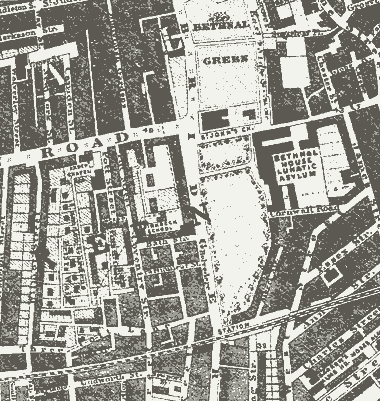
1883. How the family must have seen a change in that area of Bethnal Green between the time early in the century,
when Thomas's great grandfather, Thomas Blewet Mead, became involved with property in this part of Bethnal Green
and the 1880s. On Charles Booths Descriptive Map of London Poverty 18892, Abingdon Street and Willmott Street are
shown as "mixed - some comfortable, others poor", whilst Pitt Street is given as "poor 18/- to 21/- a week for a
moderate family". Infant mortality was high at the end of the nineteenth century, the worst year on record being 1899
when 163 out of every 1,000 babies died before they reached the age of one year.3 Presumably this statistic is an
average over the whole country; how much worse was it in the now urban areas, like Bethnal Green, than the rural
country?
 By 1883 the first seven of the babies whose lives were
recorded in the Bible had been born, and my assumption
was that many of them had lived but a short time and
that this was a typical family of the times and area.
However, plotting the births and deaths on a graph
threw up a different possible interpretation of events. I
realised that by June 1883, seven babies had indeed
been born; one daughter, Elizabeth Jane, born in 1875,
had only lived for two weeks, but the cause of her death
was given as Spina Bifida which makes an early death
no great surprise, but in June of 1883 the remaining
family of six children were alive and, probably, well.
Emily, the eldest was nine years old, George was seven,
Cordelia six, Alfred was three, Adeline two and Walter,
the baby just four months old. It would appear likely,
then, that their lives began to fall apart. By 1883 the first seven of the babies whose lives were
recorded in the Bible had been born, and my assumption
was that many of them had lived but a short time and
that this was a typical family of the times and area.
However, plotting the births and deaths on a graph
threw up a different possible interpretation of events. I
realised that by June 1883, seven babies had indeed
been born; one daughter, Elizabeth Jane, born in 1875,
had only lived for two weeks, but the cause of her death
was given as Spina Bifida which makes an early death
no great surprise, but in June of 1883 the remaining
family of six children were alive and, probably, well.
Emily, the eldest was nine years old, George was seven,
Cordelia six, Alfred was three, Adeline two and Walter,
the baby just four months old. It would appear likely,
then, that their lives began to fall apart.
Right: Bethnal Green 1862
On 23rd June 1883, Walter Ambrose, the baby of this
family of six children, died. The death certificate records
the cause of death as "Violent. Shock. Scalds.
Accidental" An inquest was held four days later on 27th June. Just one month later, Alfred Ernest, aged three years
and eight months, died. This time the cause of death was "Stomatitis. Exhaustion." In less than five weeks the family
of six children had become a family of four.
Thomas was thirty years old at this time. He had lived within a small area of Bethnal Green all of his life, but the
following year, 8th April 1884, when another daughter, Florence Gertrude Alabaster was born her birth was not
registered in East London at all, but south of the River Thames, in St Olave, Southwark. 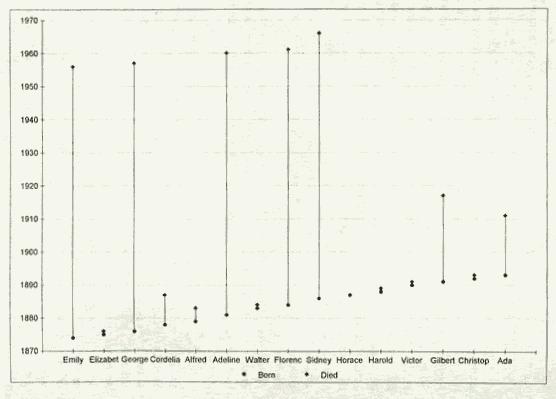 Thomas and Cordelia appear
to have moved, with their
remaining family, to a
completely "foreign" part of
London. It is easy to believe
that the tragedy of losing two
sons in such a short time had
spurred the family to move
away from their origins and
attempt to rebuild their lives
in a different area. Thomas
was employed as a Colonial
Sampler, presumably based
at the London docks, so his
place of work would have
remained unchanged. Thomas and Cordelia appear
to have moved, with their
remaining family, to a
completely "foreign" part of
London. It is easy to believe
that the tragedy of losing two
sons in such a short time had
spurred the family to move
away from their origins and
attempt to rebuild their lives
in a different area. Thomas
was employed as a Colonial
Sampler, presumably based
at the London docks, so his
place of work would have
remained unchanged.
Another son, Sidney Herbert,
was born on 1st February,
1886, as recorded in the
Bible. Once again, his birth
appears to have taken place
in South London. In 1887 the
family were living at 4 Cromwell Buildings, Southwark. At the turn of the year Emily would have been twelve, George
ten, Cordelia eight, Adeline six, Florence two, and baby Sidney just coming up to his first birthday. On 8th January,
Cordelia Catherine, died of Cerebra Spinal Meningitis Conda. The informant was Thomas Alabaster, father, present at
the death. Infant mortality might have been a fact of life at this time, but a child of eight was not an infant. How
terribly sad for the family, for the parents and the other children.
Adeline Bertha, my grandmother, was six years old then. How must she have felt at the death of her sister. Years
later, in 1903, Adeline named her first daughter Cordelia. I had assumed it was after her mother, but I wonder now
whether it was her sister she was remembering. Sadly, little Cordelia Oram was also to die before her first birthday.
By the end of that year, 1887, when Horace Edmund was born, the family had moved again, this time to the very
outskirts of London, actually Leyton, Essex.
Five more children were born between 1888 and 1893. Of these Harold John died at three months, Victor Augustus at
six months and Christopher Davidson at two months of age. I wonder if Thomas and Cordelia became hardened to
these events, or whether each one continued to hurt as much as the first. Ada Victoria, the youngest daughter, lived
until 1911 when she was seventeen. Then she died of Hodgkins disease, an ailment which now has a 90% recovery
rate. Gilbert Stephen, the youngest surviving son, died at the age of twenty-seven, on 5th April 1918 in France during
World War One.
So by the end of 1918, after fifteen births, only six of the children were living. I have been told that Horace Edmund
emigrated to Canada before the Great War, although I have no further information on this. The five remaining each
lived to a ripe old age; I just wonder what effect these early experiences had, if any, on their later lives.
The family of Thomas and Cordelia Victoria Alabaster
Thomas ALABASTER b 17 June 1853 Bethnal Green, d 12 December 1924 Walthamstow London E17, m 11 May 1873,
+ Cordelia Victoria JOLLY, b 3 October 1852 Stepney, d 17 August 1939 Walthamstow E17
|____Emily Augusta, b 30 April 1874, d 15 August 1956 age 76
|____Elizabeth Jane, b 22 June 1875, d 6 July 1875 age 2 weeks - spina bifida
|____George, b 27 May 1876, d 6 September 1957, age 81
|.........+ Fanny
|____Cordelia Catherine, b 27 April 1878, d 8 January 1887 age 8 - cerebra spinal meningitis conda
|____Alfred Ernest, b 24 November 1879, d 25 July 1883 age 3 yrs 8 months - stomatitis exhaustion
|____Adeline Bertha, b 30 January 1881, d 21 June 1960 age 79
|.........+ Ernest George Gillingham ORAM, b 11 February 1874, d 1939
|____Walter Ambrose, b 23 February 1883, d 23 June 1883, age 4 months - violent shock, scalds, accidental
|____Florence Gertrude, b 8 April 1884, d 1961 age 77
|.........+ Philip SMITH
|____Sidney Herbert, b 1 February 1886, d 7 October 1966 age 80
|.........+ Daisy Florence LEWIS, d June 1937 Dartford
|.........+ Christina Hill JONES
|____Horace Edmund, b 3 December 1887, went to Canada pre-1914
|____Harold John, b 9 December 1888, d 26 May 1889 age 5 months - tabes mesenterica (TB)
|____Victor Augustus, b 9 January 1890, d 31 July 1890 age 6 months - tabes mesenterica (TB)
|____Gilbert Stephen, b 27 March 1891, d 5 April 1918 age 27 in France serving with the 6th Battalion,
Northamptonshire Regiment
|.........+ Ruth Mary LEWIS
|____Christopher Davidson, b 12 May 1892, d 1 August 1892 age 2 months - broncho-pneumonia
|____Ada Victoria b 20 November 1893, d 31 July 1911 age 17 - Hodgkins disease
My own Nana, Adeline Bertha, must have been aware, at the time, of the deaths of eight of her siblings. She had
eight children herself. Her first son was named Ernest, after her husband, but the first daughter was Cordelia. There
followed four more daughters and then two sons. The first of these boys she named Alfred Henry; could this have
been in memory of her brother, Alfred Ernest? Her youngest baby was my father, Leslie Victor. He was born in 1919,
so perhaps the "Victor" was a reflection of the end of the war, or perhaps it was a memory of Victor Augustus.
Tracing a family history can take you right back to hundreds of years ago, as we have been very aware at the
Gatherings in Hadleigh, but this Bible and the research that has ensued, has made me even more aware of my
ancestors as real people; thinking and breathing and loving and hurting, just like us. I do hope they experienced
happiness, just like us too.
References:
Tower Hamlets Local History Library
- Charles Booths's Descriptive Map of London Poverty, 1889, pub.130 London Topographical Society, reprinted 1984
- Medicine & Health Through Time, Dawson & Coulson, pub John Murray(Publishers) Ltd
And there's more.........................!
The discovery of the existence of these pages from a Bible and the information they contained had another effect;
they produced reminiscences on the part of both my father, Leslie Victor Oram and my uncle, Alfred Henry Oram.
Uncle Alf's childhood memory that follows - he would have been about eight years old and my father aged four -
encapsulates a memory of living history and reflects a little of the later lives of two of those surviving babies, Adeline
Bertha and Sidney Herbert whose births were recorded in a Bible just about one hundred years ago.
As we go to print, I have just managed to discover the details of the inquest into the death of Walter Ambrose, aged 4
months, in 1883. I will complete the story by describing these in Chronicle Number Nine.
To go there directly, click here.
|


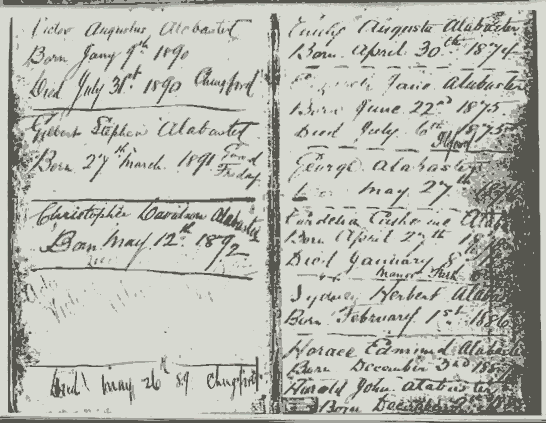
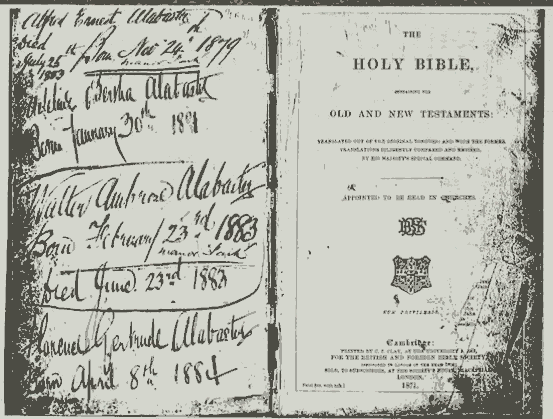 I knew that my great
grandmother, Cordelia
Victoria (nee Jolly), had had
several babies and that some
had died young, not an
uncommon situation at this
time, but until these pages
arrived, I had not realised the
full story, nor empathised and
recognised the suffering that
was part of the life of many of
our forebears. Included in the
births shown on these pages
is that of my grandmother,
Adeline Bertha Alabaster,
born January 30th 1881, and
that of Bea's grandfather,
George Alabaster, born May
27th 1876. Other names I
recognised but several I did
not; Gilbert Stephen Alabaster
had died during World War I
and Ada Victoria had died in
her teens, but what about Harold John, Alfred Ernest, Elizabeth Jane and the others who had died as babies. Of the
fifteen births, seven had died before the age of ten years, five of these before their first birthdays.
I knew that my great
grandmother, Cordelia
Victoria (nee Jolly), had had
several babies and that some
had died young, not an
uncommon situation at this
time, but until these pages
arrived, I had not realised the
full story, nor empathised and
recognised the suffering that
was part of the life of many of
our forebears. Included in the
births shown on these pages
is that of my grandmother,
Adeline Bertha Alabaster,
born January 30th 1881, and
that of Bea's grandfather,
George Alabaster, born May
27th 1876. Other names I
recognised but several I did
not; Gilbert Stephen Alabaster
had died during World War I
and Ada Victoria had died in
her teens, but what about Harold John, Alfred Ernest, Elizabeth Jane and the others who had died as babies. Of the
fifteen births, seven had died before the age of ten years, five of these before their first birthdays.