Return to the first part of Alabaster Chronicle No 28


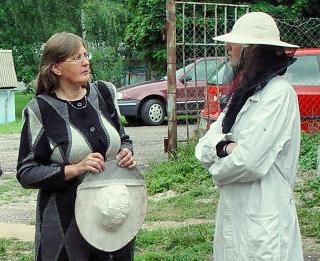
Alabaster unisex bathrobe
 
Christmas suggestions from the Editor`s Chair:
John Lewis is clean out of Alabaster perfume but offers a

Hotel Robe Unisex Alabaster


The concept of unisex Alabasters, with or without hotel bathrobes, must surely be a threat to the future of our one-name society?


Births, Marriages and Deaths

Birth:
Ella Georgie Cousins (IIIB)
, the great granddaughter of Susan Mary George (nee Alabaster), was born on 24th August 2007. Ellie is the daughter of Suzie George and Matt Cousins.

Marriage:
The wedding took place in July in London of Oliver 's daughter Clare Alabaster to Matt Sanders. First at the Registry Office, followed by the reception at a club in Shaftesbury Avenue. Clare's two little nieces were bridesmaids. There was a distinctively French atmosphere, as Clare's mother, Yvette Alabaster, is French and her sister is married to a Frenchman. It was a very pretty wedding, reports Angela Alabaster.

Deaths:
John Stanley (WofW
), aged 77, husband of Joy Stanley (nee Alabaster) died on 3rd November 2006.
Margaret Oram (IIA), aged 89, widow of Alfred Oram, daughter-in-law of Adeline Bertha Oram (nee Alabaster), died 18th May 2007.
Susan Mary George (IIIB), nee Alabaster, aged 87, died on 26th October 2007.

To Contents


An Alabaster’s Trip Way Out West

by Robert Alabaster (IIA)

On finding myself in the USA…and being somewhere else.

Krystyna and I changed our planned post-retirement US Road trip -Route 66 –‘from Chicago to LA’…deciding instead to drive the Pacific Coast from the Mexican to the Canadian borders (Route 101).

I was already supremely confident that I had the USA all figured out-

I knew all the important things:that

    • chips were fries, crisps were chips,
    • all American banknotes are the same size and colour regardless of value (Ray Charles wasn’t too happy about that and insisted on being paid for his gigs in $1 notes so that he wasn’t cheated)!
    • jay-walking is a crime but carrying a gun isn’t.

We took Route 101 in two stages. First South from Krystyna’s home outside San Francisco and then later North to Seattle. We drove along the beautiful coast to the Monterey peninsula. We stopped at Carmel and took time to have a steak in the Carmel Ranch restaurant owned by its mayor, Clint Eastwood. In the evening it was raining heavily so we took shelter in one of its many art galleries. I found myself entranced by the fine proportions of a lady in the back gallery. On noting my interest, hearing my accent and seeing my scruffy appearance the gallery owner naturally recognized that I was a wealthy rock musician who could easily manage the asking price of $24,000 for the bronze statue I had been admiring. A sale was nearly secured when I was offered free shipping to the UK…a real bargain!

The road along the Big Sur coastline was a spectacular drive through an almost deserted wilderness of sweeping bends, trees perched on perilous cliffs and stunning views of the sun setting over the Pacific Ocean. There was nothing in my experience quite like it, although it reminded me of an exaggerated north Cornish coast.

We came to a museum in the woods dedicated to the work of Henry Miller. This part of the Big Sur had been a favourite haunt of a number of artists, photographers, writers and other free-thinking undesirables of the 1930s such as Imogen Cunningham, Georgia O’Keeffe and Edward Weston. They did daring things and had complex, and changing, relationships here, away from public attention. Miller continued to infuriate people all his life: we were interested to read a letter from an outraged visitor to the museum in the 1970s vowing never to return to the museum ‘whilst that misogynistic photograph (Miller clothed, his female muse naked) remains on display’.

Further along the coast we stopped to take a photo …to feel the intense gaze of a thousand of eyes, focused on us. There below us was a beach crowded with bloated sunbathers sprawling, lazing, playing, annoying each other…and looking at us! This is where young, cool elephant seals chill out for the summer and get fat. I could imagine them wearing baseball hats and having a few beers before watching the match. They fixed us with intense and knowing stares, like those of a new-born baby…

We also stopped off at Hearst’s Castle – a gigantic playpen for the fabulously rich and beautiful of the 1930s and 40s. It displayed nearly every possible European architectural style, of every period. David Niven and his fellow hell-raiser Errol Flynn were regular visitors here, frolicking and drinking to excess. Niven had a favourite guest room where he could hide his stash of booze from the disapproving gaze of Randolph Hearst.

After the glorious wilderness of the coast south, Los Angeles was a troubling vision of a possible future:
oases of wealth and privilege, such as Sunset Boulevard, with its mile-upon-mile of gated mansions, or Rodeo Drive, which has the most expensive and exclusive stores that I have ever dared set foot in, and the most beautiful customers; and not forgetting the cars, of course- I saw more Bentleys and Range Rovers in three days in L-A than I have in a year in UK - this all surrounded by a sprawling ugly hinterland of mean streets, lock ups, and drive-thru McDonalds. Why, I was wondering, would so many people, living in such conditions, who have so little, continue to believe that they can ever achieve the American Dream?

The relationship between the eternal American landscape and the modern urban environment continued to puzzle me. Is America so vast, its wilderness so beautiful and unspoiled, its forests so enormous, its mountains so searingly beautiful as they recede into the far distant blue of the sky…that nothing can destroy them?Perhaps nothing that can be built, no new multi-outlet shopping mall that can be conceived, will have a measurable impact on the whole. The new may in some way be accommodated by, and swallowed up by the enormity of the wilderness Out There.
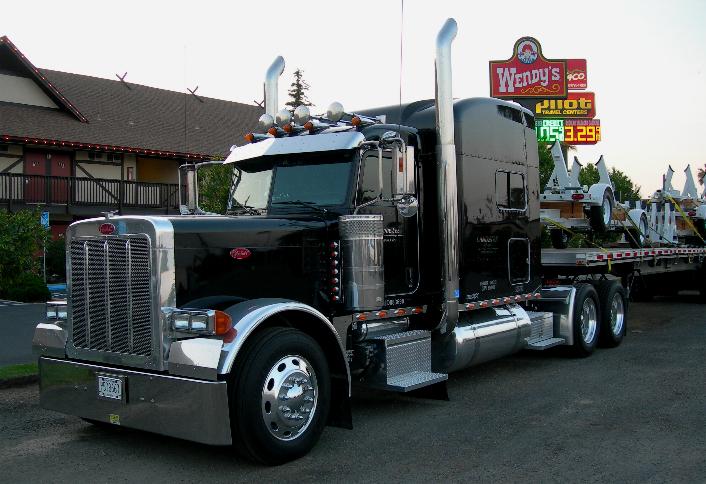
Big Truck
Robert`s new company vehicle is the environmentally-friendly model

When we travelled North from San Francisco we did, in fact, meet the Giant Redwoods, although they hardly deigned to acknowledge our presence! They seemed like omniscient, ancient beings that were well aware that they had been there from before the beginning of man’s days and will be there long after he has left – I wonder if Tolkein ever visited these trees? (and yes we did actually drive our car through one of the trees and we have the photo to prove it)!

In my travels in the US everyone I spoke to was unfailingly courteous and well mannered:
Young people hanging out in town on Friday night were not drunk, swearing or fighting  Amazing!
A young guy, a student serving me in a Pizza restaurant, conducted a pleasant, 10 minute conversation with me. Extraordinary!!

A disarmingly young police officer patiently explained to us just how far we had exceeded the speed limit-before booking us. Humbling!!!

Public broadcasting… is a beacon of calm, quiet, liberal debate. Thoughtful, intelligent, people take the trouble to phone in to discuss real questions about real issues (where is the place of the US in the world; how can we create a society that is at ease with itself) that do not seem to get an airing on the 100 or so commercial channels.

We listened to public radio a great deal, but I was not sure how many other listeners were out there… throughout my last week in the US the local (public) radio station was running a fund raising event…for its own survival! I hope that it’s still on air when I return!

On our drive back from Seattle we took the highway Interstate 5 and were so bowled over by the grandeur of Mount Shasta towering over us in the distance that we headed off in its general direction to find somewhere to picnic.

It was as I imagined base camp of Mount Everest- blinding snow- covered summit shining out in the sun. Our picnic spot was a memorial garden for the war dead of World War 2, Korea and Vietnam. As time went by we were at first surprised to be joined by more and more people…we then realized that this just happened to be Memorial Day and there was to be a special service of dedication. Not long before the service was due to start twenty or so scary, hairy bikers on Harley Davidsons turned up (they were veterans from Vietnam) who came to stand side by side with soldiers in uniform to remember their lost comrades. A memorable sight.

One of our last detours was to spend some time in California’s wine country- the Napa Valley, checking out some of the locations used in the movie Sideways. It reminded me of some parts of continental Europe with winding roads, gently rolling hills and German and Italian vineyards. I felt very at home here. By the way, the wine that they keep for themselves is FAR better than the mass- produced version that gets to the UK!

I finished my two months in the US feeling that I knew less about it than when I started. Whenever I looked for the US…it seemed to be somewhere else!!!  

To Contents


A Most Valuable Alabaster

Ian Alabaster from the Isle of Wight writes:

My eldest son Keith Alabaster works for the Home Office and is the IT technical architect for the Civil Aviation Authority in Great Britain and some of the colonies.  He has been involved with Microsoft the computer products people since 1985 and has advised them and others on various aspects of computer technology. He is involved with the development of computer servers, various gateways, and security matters via a number of committees. He supports the Experts-Exchange forum where he is the networking zones advisor and page editor for the isa server. He is also supporting Microsoft’s own isa forums.

In recognition of the contributions he has made to computer technology Microsoft have awarded him the MVP accolade (most valuable professional).  On a world-wide basis there are fewer than 4000 MVPs. The award is made to a highly select group of experts and recognizes exceptional community leaders from around the world.  In his field of operations Keith is the only United Kingdom holder of this award.

Persons nominated for the award have to undergo a rigorous review process and the panel consider the quality, quantity and impact of the community contributions. 

Keith was invited to the Global Summit at the Washington State Convention and Trade Center in 2008.

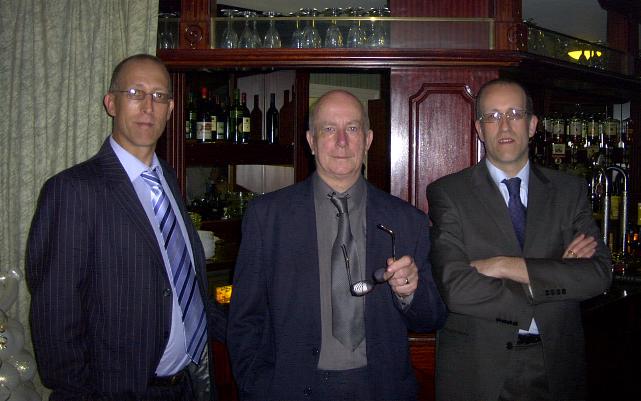
Ian Alabaster and his two sons
To Contents

Jennie Gray`s "Fire by Night",
the Dramatic Story of one Pathfinder Crew and Black Thursday
16-17th December 1943 

A review written by Cliff Alabaster

The author is Jennie Gray, whose father used to tell her bedtime stories about his escape from a burning Lancaster which crashed in the fog on returning from Berlin. The bare facts are that 25 aircraft were shot down over Germany but 31 were lost owing to crashes in fog on returning to the Cambridge area and running out of fuel.

Jennie’s father was a w/op (a wireless operator). He and the rear gunner were the only two to escape – her father with terrible injuries, but saved by an off-duty "erk", who happened to be cycling back from Cambridge when the Lancaster bomber crash-landed out of the fog. The poor rear gunner, after a month’s rehabilitation leave, was killed on his next operation.

This is the preface to the remarkable narrative, which ensued from Jennie’s painstaking research, not only into her father’s crew, but nearly all the crashes on that terrible night.

She questions whether the operation should have been "scrubbed" in view of the forecast weather. Why FIDO was so long in being lit at one airfield as to be of no use to the beleaguered airmen. The second FIDO at another airfield was lit up in expectation of the appalling weather and was instrumental in saving one crew who landed on two engines.

When the meteorological forecast proved to be only too accurate, it is surprising that the crews were able to pull out the stops and so many did, in fact, land safely. But in these operational reports on those who did not, I was disgusted to read the words "pilot error" so often!

Jennie looks in detail into the aftermath of these events, the treatment at RAF Hospital Ely and the rehabilitation centres and the later effects on those who survived and their families, not least on her own father with a startling admission in later years.

If you are thinking what a woman could know of the technical details relating to the aircraft and the later analysis of her father’s crash, don’t be put off. This is a remarkably accurate story that just had to be told. I, for one, am grateful to have read it.

Copies may be obtained by emailing jennie.gray@97Squadron.co.uk or from any bookshop, or on the internet, quoting ISBN 1 904010 37 7.

The publisher is Grub Street, 10 Chivalry Road, London SW11 1HT. The paperback price is £9.99 for 192 pages and 16 pages of b/w photos.

To Contents


Putting the Records Straight

by Moe Parry (IIA), Netherlands

In 1985 I wrote to the CWGC (Commonwealth War Graves Commission) for details of my grandfather Gilbert Stephen Alabaster’s burial place in Northern France on his death in April 1918. I was living here in The Netherlands at the time, and the chance came to drive down to Picquigny to visit the cemetery, not only for myself but in memory of my grandmother.

The information I received from the CWGC was very comprehensive, including a map and photograph of the site. They gave my grandfather’s parents as Thomas and Emily Alabaster and their address in Leyton.

It wasn’t until about 18 months ago when I started researching my roots that I discovered that Emily was in fact Cordelia (nee Jolly) Alabaster. I telephoned the CWGC about this and was advised to send them some sort of official document stating parentage. The most obvious thing was my grandfather’s birth certificate. So, off it went with a covering letter. Some weeks later they replied that the birth certificate did not tie up with any of the documents they held and suggested I got a copy of his Service Records from Kew. I thought this a bit odd as he was married to my Grandmother at the time of his enlisting and she would have been his next-of-kin, but there had been no mention of her in any of the CWGC correspondence.

In August while on holiday in the UK, I found the appropriate records at the National Archives but no trace of parentage in any of these. They did, however, have a letter from my Grandmother just a short time after his death, which I found very upsetting. Amongst Kew’s documents was also a Charge Sheet stating that GSA had been confined to barracks for 3 days for "not sweeping under his cot/bed". – What a rebel !

Anyway, all my efforts at getting this name changed appeared to be of no avail, as after a lot of correspondence, and offering copies of the 1901 census listing the entire family and even suggesting they had a look at the website, their reply was pretty negative.

I was very disappointed and was almost resolved to giving up trying, but a couple of weeks later I had an e-mail from them confirming the amendment of their records to include Cordelia and my Grandmother.

I don’t know why I had to get this corrected – it doesn’t make any difference to the headstone at the cemetery. It just seemed the right thing to do out of respect for my grandparents and I am very happy that I succeeded.

To Contents


Seen in a Welsh Museum:
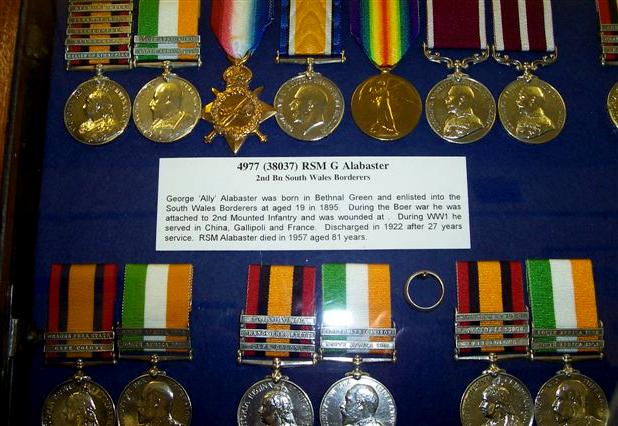
4977 (38037) RSM G. Alabaster

2nd Bn South Wales Borderers

George ‘Ally’ Alabaster was born in Bethnal Green and enlisted into the South Wales Borderers aged 19 in 1895. During the Boer War he was attached to 2nd Mounted Infantry and was wounded. During WWI he served in China, Gallipoli and France. Discharged in 1922 after 27 years’ service, RSM Alabaster died in 1957 aged 81.

RSM George Alabaster, 2nd Btn South Wales Borderers, medals
To Contents


Another Alabaster Abroad

Amy Alabaster, parasitology specialist

Amy Alabaster in Southern Bohemia

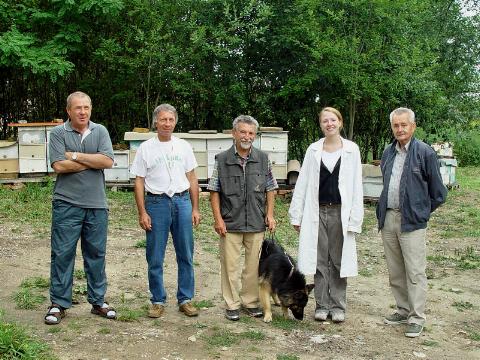
Amy Alabaster, granddaughter of Moe and Charlotte Alabaster, spent her summer vacation from her course in parasitology at the University of Arizona studying and working at the University of Ceske Budejovice.

From left: Mr Krenek, Vice-President;
Petr Stibor, Treasurer;
Mr. Stupka (with the dog), Secretary;
Amy Alabaster; Karel Doucha, Committee Member.

Ceske Budejovice is, of course, the seat of regional government in Southern Bohemia, Czech Republic. When Charlotte happened to mention this in an email to Ray Williamson, the great Alabaster networking machine instantly sprang into action. Amy was contacted by bee-keeping friends of Ray Williamson and given the VIP treatment.

After being royally wined and dined (see Note 1), Amy was warmly received by members of the Ceske Budejovice Branch of the Czech Bee-Keepers` Association and taken to their apiaries to see the work being done to control the endemic parasite of honeybees, Varroa jacobsoni.

This expedition was greatly appreciated by Amy, who had not had the opportunity to see this particular parasite at close quarters before.

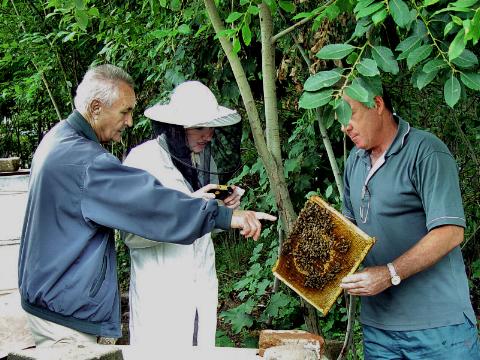
Karel Doucha (see Note 2) points out to Amy Alabaster the queen bee on a brood frame held by Mr Krenek.

Note 2: "Doucha" is pronounced "Doe-har".

Miroslava Stiborova (left) with Amy Alabaster

STOP PRESS

Note 1: Mirka Stiborova (pictured left with Amy) has sent a vital scientific amendment to the parasitology report direct from the Czech Republic:

Wednesday, October 24, 2007, 7.31 am

Dear friends,
The Amy story is excellent. There is just one little detail. We were at the apiaries first and at the dinner after.
There is a Czech saying: business comes before pleasure, which in Czech goes: work first, entertainment later.
A more accurate translation being: "First bees, then cheese, please".


Long Lost Double Cousins

by Moe Parry of the Netherlands

Meeting up with Tricia Dyer for the first time while in the UK was one of two highlights of my holiday. The other one was hearing Plácido Domingo sing at Covent Garden. This probably sounds a bit odd, but I know for a fact that Tricia will appreciate the comparison. It was lovely to be able to put a voice to our emails/photos past and present, since being in contact with each other via Laraine and the AS of course.

Tricia and I are double second cousins as our grandmothers were sisters (Lewis), and our grandfathers were brothers (Alabasters). This close blood relationship doesn’t stop there as we have mutual likes, dislikes and even friends. The last being someone Tricia and her late husband met at a concert in Vienna years ago. Imagine my surprise when her name was mentioned in one of Tricia’s emails.

Back to our meeting at Bexleyheath where Tricia collected me from the station and then took me to hers for coffee and a lot of talking, looking at old and new photographs, putting names to faces and making new discoveries.. It was just wonderful. Then on to a lovely little restaurant for a delicious lunch, where we were both good in declining the scrumptious dessert trolley. It was over lunch when Tricia remembered that she was about 6 when she had met my Grandma and Great aunt. She had not realized that ‘Aunt Cis’ was Ruth Lewis – I have no idea where the ‘Cis’ came from but have it on letters to my Grandmother from my Great Grandfather Lewis. This was like a bolt out of the blue to me and I just kept looking at Tricia thinking ‘You actually met my Grandma when you were a little girl !!’ It was wonderful.

Back to Tricia’s for teas and a photo session which was done by setting the timer on the camera and placing it on the mantelpiece, dashing back to the sofa in time for the flash. It was a good job I’d set the timer for 10 secs and not 5 otherwise I would have had to hurdle the coffee table. It was a mad senior moment and the results are now well established on my ‘Rogues Gallery’ above the pc.

I enjoyed the day and Tricia’s company so much and really look forward to our next meeting.

To Contents


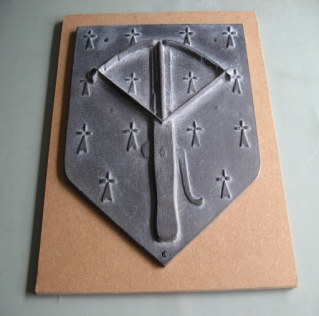
The Alabaster Coat of Arms Cast in Lead

John S. Alabaster

Alabaster arms cast in lead by Brian Alabaster, sculptorA limited edition of 20 numbered copies of the Alabaster Coat of Arms, cast by Brian Alabaster at his foundry in Suffolk, will be available on a first come first served basis to members of the Alabaster Society for collection at the next Alabaster Gathering at Hadleigh on 26 April 2008.

The price of each is £35, £20 of which will be donated to Brian’s nominated charity, Learning Through Leisure (Registered Charity Number 1061241) established for disadvantaged children: £10 will go towards Brian’s costs and £5 will be donated to the Alabaster Society.

Orders will be taken by John Stammers Alabaster, 1 Granby Road, Stevenage SG1 4AR, to whom cheques should made payable. Collection from Granby Road, or special delivery at cost, can be arranged. The plaques in the form of a shield, with the elements of the design in high relief, are 280 mm wide, 305 mm high and weigh about 5 kg. Each has three holes drilled for fastening to a board, as in the illustration, or directly to a support surface. A small illustrated leaflet describing the whole process of manufacture will be supplied with each plaque.

To Contents


Return to the first part of Alabaster Chronicle No 28