|
The Alabaster ChronicleThe Journal of the Alabaster Society
NUMBER TWENTY-NINE, SPRING/SUMMER 2008 |
|
The Alabaster ChronicleThe Journal of the Alabaster Society
NUMBER TWENTY-NINE, SPRING/SUMMER 2008 |
Contents
|
Editorialby Sheelagh Alabaster - July 2008STOP PRESSOUR SYMPATHIES TO LARAINE HAKE
|
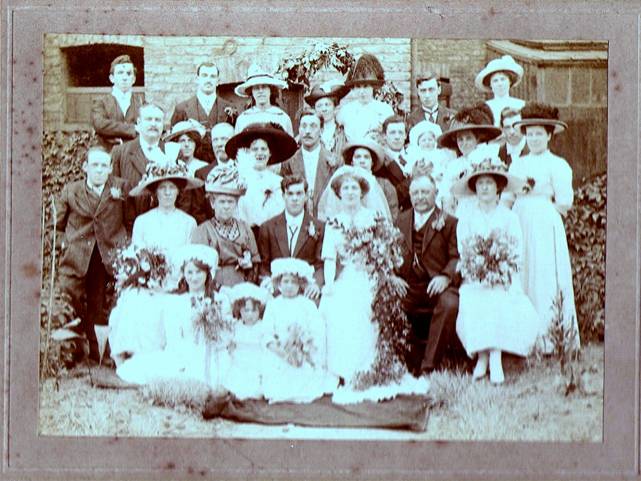
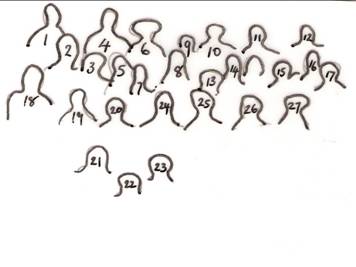
Secretary's LetterI am writing this in the evening following a very enjoyable annual Alabaster Society committee meeting held at Angela Alabaster's home in Reigate. I thought committee meetings were supposed to be boring; this one was great. We discussed and relived the Alabaster Gathering that was held in April and all agreed that it was excellent, obviously made so by the wonderful people who attended it. The only criticism - and I am assured that this is constructive criticism - was that we did not allow enough time for people to just talk and interact with each other. I am sure we can sort that for 2011. I would like to say a great big Thank You to those of you who were able to attend and who did make the eighth Gathering so good. For those of you who were unable to come, many thanks for all your good wishes and for being there with us "in spirit". Otherwise, on the Alabaster front, there have been various happenings, some of which you will be able to read about in this Chronicle. An additional outcome of the Gathering was that Matt Alabaster (IIA) told his cousin, Jenny Osborne, all about the day. Jenny's mother was an Alabaster and Jenny has since shared lots of Alabaster photographs with us. A direct consequence of these shared photographs was a visit by me to meet an existing member of the Society, Mary Rudd, whose mother was also an Alabaster. (Mary is Jenny's first cousin once removed. One of the photos we looked at was the group wedding photograph of Mary's parents, Ellen Elizabeth Alabaster and Robert Rudd who married in 1913. One of the bridesmaids was actually Gertrude Louise Alabaster, mother of Jenny, but the great excitement for me, I must admit, was that the photograph includes the father of Ellen Elizabeth, Edwin Alabaster, who happens to have been the brother of MY gt grandfather Thomas Alabaster, of whom I have no photograph - well, what's the point of being secretary of a wonderful society if I cannot selfishly put myself first on occasion? I find this just so exciting! It makes me wonder what else can there be out there, still waiting to be found? The exciting photograph follows, including a key to the persons Mary could name. Can any of you recognise any of the rest? With love to you all - please do not overlook the subscription renewal reminder enclosed! Laraine. |
An Amazing Donation to the SocietyAn anonymous donor has generously given the Alabaster Society £2,000 to be spent as the members of the Society consider best. We will be discussing at the next Gathering the ways in which we could use this money, although no specific decision has to be reached then: we could instead decide to gain interest on this sum until such a time as a specific piece of research or an acquisition becomes obvious to us. Please would any member who is unable to attend the Gathering but who would like to offer a suggestion please contact me to let me know his or her opinion to be heard when we do discuss this in April. Shirley Alabaster, Treasurer. To ContentsSample Translations of the book Apparatus in Revelationem Jesu Christi
|
Translation by Brooke Foss Westcott of the preface to Apparatus in Revelationem Jesu Christi by William AlabasterTo Catholic Readers Just as Christopher Columbus, in the memory of our fathers (when, beyond the expectation of all, he had discovered in that vast ocean a new world) took back to Spain unrefined gold, and scarcer stones, as tokens of that rich land; so I, in just the same way, when I had detected another scripture lying like a new world beneath this common and well-trodden one, and had examined it from all angles, now exhibit to you, to prove its reality, certain readings and interpretations of the same, like metallic ores radiating much light of knowledge, and heavy in their strength of trustworthiness; and, moreover, the manifold gems of unknown and astonishing wisdom. It is not yet time, I think, to relate what signals led me into this investigation, what a struggle I endured, or how many risks I had to contend with before I lighted upon this land, even if it were conceded to be possible; this can wait until the message of this book has flowed through willing ears into your affections. It would have been foolish to exaggerate its worth because of the extended labour, if the hard work done in its name had run its course but not taken the prize. And storms are reckoned as spent by sailors much too quickly when the peril of shipwreck hovers before the port itself(1). Nor do I so greedily put a price to my discoveries, for without the well-known hallmark and seal of your name I might have sold this gold and these stones for a trifle. With that in view, test out these first samples from this new mine in your most precise judgement, as if firing them over and over in a furnace, and with your harshest file expose these rough diamonds(2): and if any be found not genuine, or rough and impure, I say there is no reason why it should not be repudiated and utterly rejected, so that it might not carry the stamp of public currency, or contribute to the edifice of Catholic truth. For however much this new world may offer us a specimen of riches, nonetheless it would still have been all dry and dirty, and unfit for human use, unless, from its first ecclesiastical proving, it had dragged along currents of a constant stream, whose convergence is like whirlpools from the collective bubblings of many individual ones, and whatever proceeds identifies an automatic tendency towards the truth(3). But I am uplifted by a good expectation that there will be an impartial admission [of my correctness], with so many examples concurring one after the other, like a huge bunch of purple grapes, and that this may make out the case for how fruitful the land is, and put other people in mind to take possession of it. For how greatly important will the study of a universal theology be in the future? If there is an explanation of all the difficult places, and a full account of the forms of its laws, and a commentary on the mystical meanings, then these inferences of the internal text must be taken to come from God himself. With how much a sense of genuine delight will the soul of an understanding person be bathed when he has accepted the rational conformity of the divine word in every single voice, and has observed the conjunction of the symbolic meanings with the literal significance, perpetually meeting, like cherubim, through mutual respect. Finally, how much admiration will the infinite wisdom of God draw from the attentive reader? The God who, under the external binding of his scripture, has hidden his secrets away from both Jews and heretics, in order that Catholics might in future times have solace from consciousness of the holy faith, when they have seen this, which they had heard foretold by the mouth of the church, rooted in the heart of the sacred letters. For just as with in embroidered muslin, some threads of the design seem hidden to people looking at it from behind - that is, on account of the crosswise stitching and bending round of the threads, one cannot appreciate the quality of the pattern or its beauty - yet those looking from the front can feed their eyes and satisfy themselves with the proportion of the lines, and the sophisticated colouring: so the form of the Catholic faith, which is woven obscurely and unevenly in the back of the scriptures, is represented in an inner reading so beautiful and precise that it cannot be doubted that those threads which are crossed over and broken off on the exterior tapestry have been made so with this plan; in order that they can display the web of the inner scripture in its proper proportion. And in order that someone yielding to prejudice might not erode the truth of this matter, and suggest that this whole thing is but a figment of my imagination, I now promise (a solemn vow of my faith having been anticipated) that this demonstration of divine wisdom in this book will be seen to go beyond the work of human ingenuity, and what is more, of fabricated intellect. [I promise] that if anybody should hold its novel appearance to be suspect, and disparages its faith in spite of its proven story: then the same work will trample into the grass the origins of everything that has been found. For all this kind of thinking, with which all the present books of scripture teem, was unheard of for many centuries after Christ, and for all those before then. Also scholastic discipline, and the method of treating holy things according to the principles of the Peripatetic philosophers, did not find its way into use for many centuries, but now it holds first place amongst other methods of study. I will put aside the institutions of religious brethren, and many rites of the holy church, which, with the mature growth of learning in the body of Christian truth, have explained themselves. Lastly, everything that has overburdened its novelty with the weight of many years was new once upon a time; and it is the way of things to be done by the example of greater things, before they themselves provide an example to lesser things. Even our Lord himself, when he gave his definition of the scribe who has become a disciple in the kingdom of heaven(4) as the one who knew to bring out of his store things both new and old: just as he did not disparage the old, neither did he forbid the new: but both of them he linked together in a happy binding, in order that the fabric of posterity might provide a foundation for novelty, and the ornament of novelty might add grace to posterity. How finely this was prefigured in the putting together of Solomon’s temple, in which the sound of no mallet was heard: so that in the structure of Catholic truth, neither could any clash of words colliding against each other be noticed(5). [I promise] that it has been constantly and religiously observed by me, and will be observed in the future, that I would not set my pen against the smallest letter of Catholic doctrine. But just as people curious about ancient events rub away the verdigris that has eaten away at old inscriptions, in order to bring back into the light the elusive letters beneath: so have I tried to expose the tablets of divine law, covered over by the outside matter overlaid, in order that I might exhibit monuments of divine wisdom and Catholic faith incised by the finger of God. If indeed, through thoughtlessness, any word has escaped me which might decry the smallest part of the well-known harmony of faith, let it be both revealed and eaten up at its very birth. For although the flow of the whole argument is connected by the principles of proof, I would not want to announce a single one of them openly and assuredly, but it wavers in hesitation, awaiting the stroke of your censure. If any distrustful person still wonders about either the magnitude of the matter or my humility - how can that which was secret for ages now be sought out? or how was that which escaped the notice of so many men learnt by me? - let him diligently ponder the examples of this interpretation, and if in fact he should derive no glimmer of proof during the reading, then let him stop asking how a thing can exist which cannot be seen: but instead, if he can be compelled to assent to the strongest forces of reasoning, he may have the image of his answer, if he can see done that which he was unsure in logic could be done. [And I promise] that if God is to make trial of his power, or if understanding might make the Catholic church’s womb fruitful, as once it did the ageing Sarah’s(6); and after he rekindles the dead flames of lively understanding, with which our forebears grew hot in their youth, to a new desire in the Northern (that is to say, dull) man, for the gift of divine understanding: then rightly will the church have said, “God has made me laugh; everyone who hears his word will laugh with me(7).” Your humble servant, William Alabaster. Notes to the translation of the Preface 1. The suggestion seems to be that instead of riding out a storm, sailors near their destination may be tempted to run
for port, and be dashed on the rocks as a result. Therefore Alabaster laboured long and hard rather than dash swiftly
towards a conclusion. Translation by Brooke Foss Westcott of pages 9 & 10 of Apparatus in Revelationem Jesu Christi by William AlabasterBut before I get to the complete constructs of the mysterious scripture that need to be explained, I will set out various men’s names which (that same holy spirit attesting) were made up from other sounds: from which it may become apparent that the etymology of other words is not outside the text’s intention; or indeed the separation of the syllables in reading, which is backed up by similar examples throughout. And since the whole argument of this book leads from this - that from the breaking up of words, the internal senses of the scripture may be derived - therefore the starting point of that which is to be explained will be introduced, whereby the use and authority of the whole method is demonstrated. I understand the first names imposed were those which were given by Adam to all the animals, of which this history may be had; The remainder of this article contains Greek and Hebrew letters which cannot reliably be reproduced on a web page, so it is available in this Word file. To Contents
|
The Alabaster Gathering – Sunday 27th April 2008by Christine Benner (newly discovered Alabaster, belonging to Branch IV)
My husband and I arrived at the
church where a very lively
family service was in progress
with lots of children happily
joining in with the hymn
singing. No hymn-books were needed as a huge screen digitally displayed the words, encouraging the congregation
to sing heartily. After the service our group met outside the Church where Elaine Everitt, an Ipswich town guide, steered us away from
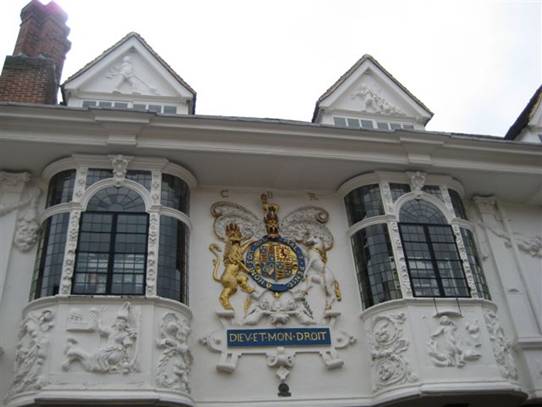
some ugly 1960’s towers to the interesting nooks and crannies of Ipswich. A house in charming Buttermarket (pictured above) reputedly
has one of the finest examples of pargetting on a house in this
country. A merchant by the name of Sparrowe, whose house
was also next to the fish market, owned the house 300 years
ago. He arranged to have the fish market moved! Among the
depictions in the pargetting were representations of four
Continents – Australia had not been discovered at the time of
the work. One of the smallest and oldest
houses in Ipswich, dating from
the 15th century, could be seen from the churchyard of St Mary-le-Tower at the back of
Northgate Street. The splendidly dominating Town Hall in Cornmarket dated from the
Victorian era. William Pykenham, who was Archdeacon of Suffolk from 1471 and Rector of Hadleigh,
built the Pykenham Gatehouse (left). Cardinal Wolsey, (1475-1530) Henry VIII’s Lord
Chancellor, was born in Ipswich. The family of Geoffrey
Chaucer (1340-1400) owned a tavern in Ipswich and
Thomas Gainsborough (1727-1788) spent his formative
years in Ipswich. We all walked at a fair pace down to the Quay and were ready for lunch at “Isaacs” formerly a merchant’s house. Thanks to Laraine’s arrangements for the day, we were much wiser about a town where some of our Alabaster ancestors had lived their lives. To Contents |
|
Continue to the second part of Alabaster Chronicle No 29
|

 1.
1. I had intended to be present
only at the Saturday Gathering.
On Sunday morning I felt I
wanted to be with our family
again, and wondered whether
we could catch up with the
events in Ipswich – a church
service at St Matthew`s (where
some Alabasters were
baptised, married and buried)
then a guided walk around
Ipswich. Lunch had been
arranged at the quayside
overlooking a marina on the
River Orwell, at “Isaacs”.
I had intended to be present
only at the Saturday Gathering.
On Sunday morning I felt I
wanted to be with our family
again, and wondered whether
we could catch up with the
events in Ipswich – a church
service at St Matthew`s (where
some Alabasters were
baptised, married and buried)
then a guided walk around
Ipswich. Lunch had been
arranged at the quayside
overlooking a marina on the
River Orwell, at “Isaacs”. 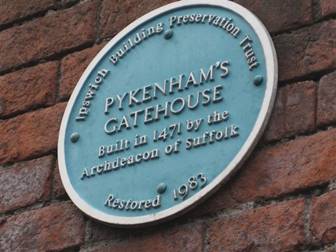 The day was sunny but breezy.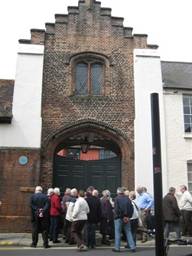
 He also built almshouses in Hadleigh and one
of the trustees of the
almshouses was Thomas
Alabaster of Hadleigh.
He also built almshouses in Hadleigh and one
of the trustees of the
almshouses was Thomas
Alabaster of Hadleigh.