Return to the first part and Contents list of Alabaster Chronicle No 30
Continue to the final part of Alabaster Chronicle No 30


Going to Australia

Responses to Laraine's gold-digging on our behalf.
With additional contributions from downunder from Beryl Neuman, Murray and Joan Williamson, Walter and Joan Eacott

My Emigration Story - first published in the Sixties

by Beryl Neumann

My girlfriend Jennifer and I left London Airport on a BOAC Boeing 707 on the 24th January 1963 on a cold and crisp day. We went from cold to colder, landing in Frankfurt and then onto Zurich where it was snowing. This was followed by the hot brown barrenness of the Israeli and Persian countryside and was in sharp contrast with the comfort and hospitality of their airports. Later the white marble buildings of New Delhi could be seen under our left wing and at the aerodrome the hot Indian sun beat down mercilessly on the passengers emerging from the aircraft to stretch their legs. We then proceeded on to Rangoon and to the 90% humidity of Singapore at 2 a.m. After a break to refuel we were glad to take off. Dawn in the aircraft came almost an hour earlier then our earth-bound brothers and sisters and soon noses began to press against windows to catch the first sight of Australia.

Darwin Harbour looked magnificent, with the limpid turquoise of the ocean merging with the green tropical grasses of the land. It was still very humid on the ground. The longest section of the whole trip from Darwin to Sydney was still to come - just how big can this new country be? Sydney - beautiful harbour, widespread suburbs, golden beaches and a bustle apparent even from a mile above! The Bridge could have been likened to a perfectly symmetrical plastic toy, large as it was. We touched down at 6.30. a.m. the temperature was already 75 degrees.

Although I have many pleasant memories of England, I cannot regret leaving it, as the Australian way of life is too full and rewarding to permit such feelings. Anyway, what's the difference? there is such a high proportion of Englishmen here!

My Big Adventure - travelling thousands of miles, making new friends and adapting to a new environment has been extremely successful and I can only qualify Australia as IMMENSE.

A month later I would meet a very nice young man from Germany and 4 weeks and 6 days later I was engaged to this nice young man called Hans Neumann and we have been happily married since December l964.

From that time we both worked long hours and saved our money and in 5 years we had bought a block of land, built our house and paid it off. Only then did we start to explore this Large Island Downunder.

*********************************************************

From: Murray Williamson, Canberra:
Judy is the Alabaster descendant; we are both descended from 19th century immigrants.

All of Judy's forebears came to Australia in the 19th century, some as convicts in 1814 (beats the $10 Pom lark - transport was free, but it was strictly a one-way ticket)! as well as free settlers in the 1830s and 1840s and 1850s, and as Irish assisted immigrants in the 1850s and 1860s.

One of Judy's ancestors was only a child when she was transported with her mother - the mother was indigent; she had stolen a dress in London and pawned it: she was quickly sentenced to death, but the sentence was commuted to transportation, no doubt because the State would have had to look after the child!

Alabaster migration to Australia: In the Alabaster Chronicle No 18, The Gibson Girls, I recounted how Ann Rodd travelled with her daughter Mary to Australia to visit two of her sons, and how Mary fell in love with the ship's captain, married him, and went on to live in New Zealand.

Ann was the daughter of John Alabaster of the Half Moon pub at Rayleigh, Essex, and her husband, James Rodd, was an auctioneer and long-time parish clerk of Holy Trinity Rayleigh.

Ann's sons, James (1830-1900) and George Palmer Rodd (1837-1903), arrived in Sydney in December 1857 as passengers on the Duncan Dunbar. What drove them to leave England at that time is not known.

George at first worked for a pharmacy in Sydney. James soon found his way to the Braidwood in southern New South Wales, then in the midst of a gold mining boom. There he established the Free Trade Stores. The business flourished, and James sold everything from miners' paraphernalia including blasting powder and fuses to butter, bacon,flour and fruit, oilmen's stores, clothing, timber and hardware, wines and spirits. George joined him in 1859 and set up a dispensary in the store "replete with every requisite for Nursery and Toilet, Genuine Drugs and Patent Medicines".

James married in 1861 but in the following year his wife and infant child died soon after the birth. He became active in public life. He was the Member for Southern Goldfields in the NSW Legislative Assembly from 1865 to 1869 and for Northern Goldfields from 1872 to 1874. He became a JP and magistrate, and he married again in 1871. His public life came crashing down in 1874 when he became bankrupt due to speculation in gold mining. However, he rebuilt his fortunes as an auctioneer in Sydney and one of his homes - Pinaroo in Burwood, Sydney - is listed on the National Heritage register.

As well as being a partner with James in the Free Trade Stores, George set up a flour mill in Braidwood. He married in 1872. He too became bankrupt in 1874 due to gold mining speculation. He worked as a roads supervisor in Crookwell and Goulburn before moving to Bega, on the NSW South Coast. There he became a member of the fist Bega municipal council, and he too became an auctioneer. George had seven children.

In 1865 James and George were joined by another brother, Ephraim (1834-1915), his wife and child. Family tradition has it that when in his teens Ephraim was sent to Germany to teach English to his uncle's children. (I have no idea who this "uncle" was. When his uncle went to America Ephraim accompanied him. Ephraim married in Illinois in 1861-82, but returned to England after the American Civil War started. His brothers advised him to come to Australia. At first Ephraim farmed in the Braidwood area. In the early 1870's he had a store, apparently in conjunction with James, at Adelong, another gold mining town in southern NSW. In the early 1880s had a store at Tarcutta, a small town whose proud boast to this day is that it is half-way between Sydney and Melbourne. Ephraim was bankrupt in 1884 because "business lately has been too dull". He had eleven children.

From Walter and Jean Eacott:
As we were ten-pound Poms and as Jean is the descendant here I've told her to get on with the job. She could start with the fact that although I was interviewed by the RAAF and accepted for service in London, they wouldn't engage me until we arrived here, and I was directed to the "ten-pound queue" of the Immigration Dept for a sea-passage to Australia.

When I discovered that airmen were being signed-on in London and were getting paid before they ever left England, I protested to Australia House, and was told, " Ah, they are joining as airmen, but you are being Commissioned!" The inference was that we were well able to afford not being paid for five weeks. What an old-fashioned notion!

To Contents

Ann Margaret (Nan) Criddle Kenyon,

Great Granddaughter of Mary Ann Alabaster
1 January 1922 - 25 December 2008
From Myrna Brandon-Paquette, (g-g-granddaughter of Mary Ann Alabaster):  

I first met Nan Criddle in Manitoba about twenty-five years ago. She and her husband, Gordon Kenyon, made the 1800 km trip in their motorhome from Penticton, British Columbia, to the original family homestead at Aweme, Manitoba, many times over the years. They attended each Criddle Family Reunion and, after the homestead obtained Heritage Status from the province, participated in several annual reunions which the Heritage Committee promoted on the Criddle Homestead.

I was aware of my connection to the Criddle family mainly through the book "Criddle-de-diddle-ensis", written by Alma Criddle, a cousin of Nan's. It was only after meeting Nan that I became attracted by all aspects of researching family history. Nan introduced me to the Alabaster family, her Great Grandmother being Mary Ann Alabaster, artist. Soon I was researching and collecting information on not only my Criddle and Alabaster ancestors, but also on all my other ancestors. Nan is largely responsible for creating in me this intense curiosity about those who made me who I am.

On first meeting Nan, I came to know a caring, most interesting relative, one who shared, through the following twenty-five years, my great love of family history. She proved most co-operative and useful to our common goals. She no doubt was our family's master historian/archivist. She was very generous in sharing her knowledge and the documents and photos which had been passed down to her through Mary Ann Alabaster and her son, Percy Criddle. Because of her, and her late cousin Flora Vane Mooney, the unique Vane/Criddle family history in their possession has been preserved and passed on to the next generation in excellent shape. I have no doubt that she would be pleased to see her work carried further by following generations.

With great sadness, I learned of Nan's passing on Christmas Day, 2008. Perhaps she is some place where she can see how much she was appreciated, how much all who knew her cared for her. We will miss her good nature and smiling face.


Nan Criddle Kenyon
From Laraine Hake

Between Christmas and the New Year, I was very sad to receive the news that Nan Kenyon had died on Christmas Day. For the last while, she had been suffering badly from Alzheimer`s so perhaps I would not want to wish her back, but the news did spur me to dig out the letters we exchanged in the early 1990s at the very beginning of the life of the Alabaster Society.

It was just so, so, exciting to be contacted, out of the blue, by somebody as far away as Canada who had so very much information to offer about the Alabaster family, Branch IIC in particular. In 1992, I was already aware of the Alabasters in New Zealand who were descended from Rev Charles Alabaster, eldest son of John Chaloner Alabaster and his wife Sophia. In fact Molly Duffy, gt granddaughter of Rev Charles, had travelled from New Zealand to attend the very first Alabaster Gathering in 1990. I had also heard a little about Henry of Siam, the second son of John and Sophia, and Sir Chaloner Alabaster, the youngest son. What I had not realised was that Mary Ann Rebecca Criddle, nee Alabaster, the aunt of the three boys who appeared to have raised them after the deaths of John and Sophia at the ages of 33 and 32 respectively, had herself had one son, Percy. He had emigrated to Canada in 1882, taking an inordinate quantity of letters and papers with him which had survived. Thus, Nan was the custodian of so much information.

I decided that I would share her very first letter to me with you all. Nan and Gordon visited Hadleigh and came to one of the Alabaster Gatherings - I believe it was the 3rd in 1993. She was a lovely lady and I am very grateful to her for all she shared.

Sept 4 1992     Dear Laraine,

I am absolutely overwhelmed!! I really don't know where to start!! I have so much I want to tell you - and so little time to do it as we are leaving on Tuesday for a trip back to Manitoba & will be away for six weeks to two months - so I have much to do to get ready! However, I am going to take my papers with me & hopefully, I will get time to write to you along the way.

I can't believe that my phone call to Irene Alabaster could result in all this excitement! I have always admired my Great Grandmother Mary Ann Rebecca & since I got the "black box" from my brother Percy Criddle II - I have found out so much about her - & I admire her even more. I think she was a very great lady & very much ahead of their time in her thinking.

I received a very prompt reply to my first letter to John - & then I received a second letter from him & yesterday your letter came. John suggested I should write to you as you are the official custodian & all information will be passed on to him & Adrian from you.

Before I go any further, I will tell you a little about myself. My father was Stuart Criddle, son of Percy Criddle I (who was Mary Ann Rebecca's only child,) I have one brother Percy Criddle II. The story of the Criddles is quite fantastic & rather than try to explain it all I am going to enclose some clippings about the family. One of my cousins also wrote a book about them which I will send to you later on - it is based on my grandfather's diary. I have a copy of this diary also. (I started out to tell you about myself & got side-tracked!) I must be a generation ahead of you as I have just turned 70. I am married to a very wonderful husband - Gordon, & we have 3 children......and 3 grandchildren. I was an art teacher until I was married.

And now to the questions in John's letter and also to thank him for the pamphlet on the Alabaster gathering. I have the "tree" made out by Grenville Alabaster which seems to be full of mistakes - he hasn't even got his cousins' names right! I did not know anything about Henry of Siam having married ? a Siamese ! & having children by her?! I have letters written by Palacia to Mary Ann & there is no mention of a separation - she lived until 1904, quite a while after Henry died. Those Siamese girls are very beautiful so maybe he was following the footsteps of his cousin Percy!!

John wanted the full references to my notes on Mary Ann. I saw a book advertized in a magazine "The Dictionary of Victorian Painters 2nd Edition 1837-1901" by Christopher Wood. The local library didn't have it but I was in Vancouver soon afterwards & found the book in the library there. The Write-up wasn't very long but the references were:

English Female Artists (1876) by E. C. Clayton & History of the Old Water Color Society (1891) by J. L. Roget.

I don't have much information on Charles (1775-1820) but I do have some, & a large telescope is mentioned & also some kind of invention in the manufacturing field - I believe to do with spinning. This is in some notes Percy I made for C. Grenville - & Percy I also mentioned that J. Chaloner (father of the 3 Alabaster boys) had burned all his father's papers when he died!

I am certainly willing to share any information I have with you. And I imagine you'll want as much as possible before the gathering in April? Percy II has the portraits of Charles & Mary (Dearmer) & I'll either get him to have them copied or I'll go over there to Victoria myself after we get back from Manitoba - a laser copy would probably be best.

The question of Mary Ann's birth place is puzzling. I have the copy - in her own handwriting! - of the write-up she sent to Ellen Clayton & she says "born in Holywell Mount, Chapel House in 1805". She was getting on in years when this was written & Percy had helped her with it. There are several letters from Clayton, one informing Mary Ann that the book had been published. In the copy of the 1851 census which you have sent me she is listed as having been born in London. Maybe some of you can solve the riddle......

This is one riddle that I was able to solve. Mary Ann was indeed born in Holywell Mount, Chapel House in 1805, but this was NOT Holywell in Wales, as presumed by the author of the book, but Holywell Mount, Shoreditch. In fact, various of Branch II lived in Chapel Street, Holywell Mount, Shoreditch at the beginning of the 19th century, and Mary Ann Rebecca was baptised in St Leonard's, Shoreditch on February 9, 1806. 

Sept 6
Had to stop then or else I would have been chasing ancestors all night ¬ able to sleep! Yesterday my daughter & family came down for the day ....... & after entertaining grandchildren - & feeding them all, I didn't feel up to writing letters. Today I have been getting the motor home ready for our trip east - & now I must sit down to finish this letter.

Incidentally we do a lot of travelling in our Winnebago - (27' long motor home). We have been across Canada, to Alaska & every winter we go south to Calif - we were back to Manitoba just last year.

Your letter is so interesting! I wonder where Chaloner was when that 1851 census was taken - away at school perhaps? He was born the year after his father took the trip to America, Henry the year before the event. I think I have a list of where Mary Ann etc were christened - will check it out.

Janet Alabaster, widow of Austin (Charles's son) was my brother Percy's godmother. But after she died we lost track of the New Zealand Alabasters. The picture you sent of Chas Alabaster - I have the same one but had no idea who he was!! There are so many un-named photographs - there must be pictures of Henry & Chaloner too. I mentioned to John that I had one of Henry's boys. It was interesting to see Chas' sons named after Chas's brothers.

I have piles of papers on the Indian Land Claims including the receipt dated London June 26 1832 - "Received of Mrs Mary Alabaster the sum of Twenty Pounds, for two original grants of land in Upper Canada" Signed by Ann Jones. I have always intended to write the whole affair up - but I think it is beyond me now. Maybe Adrian would do it and include it in his book.

Before we leave tomorrow I'll get Gordon to photocopy some write-ups on the Criddles for you. There are mistakes in them - reporters tend to make these! The facts are:- Percy went to Germany to study - he met Elise Harrer there (not Vane) - he was good friends with her family who must have been fairly upper class - Percy was a complete snob & would only associate with those he felt were his equal! Anyway she went back to England - no proof as to whether she went with him or whether she followed him. She had 6 children by him - (not 5) - the first one Mabel died as a baby. I have 5 of the birth certificates and the 3 boys Edwy, Harry & Cecil were listed as Criddles, she as Elise Criddle formerly Harrer - & Percy Criddle. The girls are listed as Vanes (Mabel, Minnie & Isabel) - Mother Elise Vane formerly Harrer - & father as Percy Vane. Isn't that something!! Percy went on to marry Alice Nicol in 1874 & had 8 more children. No one knows for sure what happened & why he came to Canada. Did he marry Elise so was he a bigamist?? - or did he run out of money with such a large family to support so decided to try his luck out here??

Gordon bought a computer a couple of months ago & wants me to learn to use it so I can file all my family history on it - but I haven't had time to do anything about it yet.

We had a family re-union in 1983 back on the old farm. The last of Criddles & Vanes - Aunt Maida Criddle died in 1982 & was buried back at the family cemetery. Many of the family attended & we decided we would have the re-union the following year, 101 years after the family had arrived there from England. I did a Family Tree - from 1882 - 1983 of the two branches Criddles & Vanes.

== We are leaving this morning!! I will get this into the mail - muddled up as it is. Please return the two write-ups I have marked "R".

If you want to contact me - you could write to the following
c/o Miss Mona Vane............
We will be there the last week of Sept - this was where Charlie Alabaster (son of Henry) lived. He came to Canada in 1903 - couldn't get along with his cousin Percy! He died in 1945. I'll try and find out more from Mona - I know he received money from England - he was really well educated & spoke several languages - but he was rather a "strange" person!

Very sincerely - but in much haste!
Ann
I am called "Nan" by the family.

We exchanged many more letters and then emails , which are not filed as carefully, in the years that followed and Nan and Gordon visited Hadleigh and came to one of the Alabaster Gatherings - I believe it was the 3rd in 1993. She was a lovely lady and I am very grateful to her for all she shared.


More about Nan
From: Myrna Paquette
Nan contributed so much to our knowledge of Branch IIC

Just received your email at the same time as I received another from the Manitoba Heritage Society saying that Nan had died on Christmas Day. She contributed a lot to the family history. We will miss her. Here is the obit from the Winnipeg Free Press, published on December 28, 2008:

    (ANN) NAN KENYON (nee CRIDDLE) Born January 1, 1922 - passed away at Village by the Station, Penticton, BC December 25, 2008 after a happy life. She is survived by her husband of 50 years, Gordon, her daughter, Carla (Doug), son, Kerry, daughter, Sandy (Gordee), grandchildren, Eric, Katie and Sidney and brother, Percy Criddle. Nan was born to a pioneering family in Treesbank, Manitoba, and was very involved in the Criddle family history. She was a teacher in rural communities in Manitoba, then moved to Penticton and taught at Pen-Hi in the 1950s until she married the love of her life. A daughter, a sister, an artist, a teacher, a wife, a mother, a volunteer, a grandmother and most importantly, a friend.


And from Oriole Veldhuis:

I very much appreciate your sharing. Myrna and her husband are fine writers and everything she said I can agree to.
I could add to Myrna`s contribution by saying that I really got to know Nan one summer when I was working in British Columbia and my father encouraged me to look her up in Penticton. I found her one evening. She and Gordon had only just arrived home from Vancouver Island with newly adopted twins. I felt right at home -- my mother had twins when I was 10, and I was quite comfortable giving some help and advice. We have been friends ever since. I will miss her.
Oriole.

To Contents

 
New Zealand Gazette: Shirley Ellen Alabaster honoured

Birthday Alabaster Honours for Mrs Shirley Ellen Alabaster

spotted by Ivor Smith
WELLINGTON: WEDNESDAY, 11 JUNE 2008 - ISSUE NO. 97
THE QUEEN'S BIRTHDAY HONOURS 2008
THE QUEEN'S SERVICE MEDAL

The Queen has been pleased, on the occasion of the celebration of The Queen's Birthday, to make the following awards of The Queen's Service Medal.
Q.S.M.
Mrs Shirley Ellen ALABASTER, of Alexandra. For services to the community.


The London Gazette

Did you know that the London Gazettes are searchable online? Here are a couple of excerpts. NB Lots of Alabaster Wests, Easts and all directions of the rainbow - I suggest you all have a root around. I found a non-Alabaster grandfather working for National Insurance in 1921 when he was thought to have died in the trenches. Ed.

1929
Post Office: Contract Officers, Charles William Crisp, Francis McDonagh, George Thompson Matchett, John Sharp, Sydney Arthur Smith.
Male Sorting Clerk and Telegraphist, Hitchin, George Henry Bowles.
Skilled Workman, Philip O'Brien.
Telephonists, London, Dorrit Louisa Alabaster, Frances Emily Benson, Norah Ellen Northover Jackson, Eveline Minnie Sex, Marjorie Elizabeth Viccary, Hilda Florence Maud Warr.
Telephonists, Ethel Gavins (Leeds), Betty Irene Pickersgill (Leeds), Hilda Rosina Thornewell (Birmingham).
Postman, l. Faldon, Chelmsford.

1875
NOTICE is hereby given, that by Indenture, dated the 7th day of April last, Robert William Alabaster, of No. 388, Essex-road, Islington, in the county of Middlesex, Milliner, assigned all his estate and effects whatsoever and wheresoever unto Frederick Suowden, of No. 81, Shoreditch, in the county of Middlesex, Warehouseman, and James Boyes, of No. 2, Carey-lane, in the city of London, Accountant, as Trustees, for the general benefit of creditors. All creditors who have not sent in, particulars of their claims are Requested to send the same forthwith to Messrs, Minton, Boyes, and Child, Accountants, No. 2, Carey-lane, in the city of London. -Dated this 6th day of May, 1875.
PHELPS and SIDGWICK, 3, Gresham-str.

To Contents


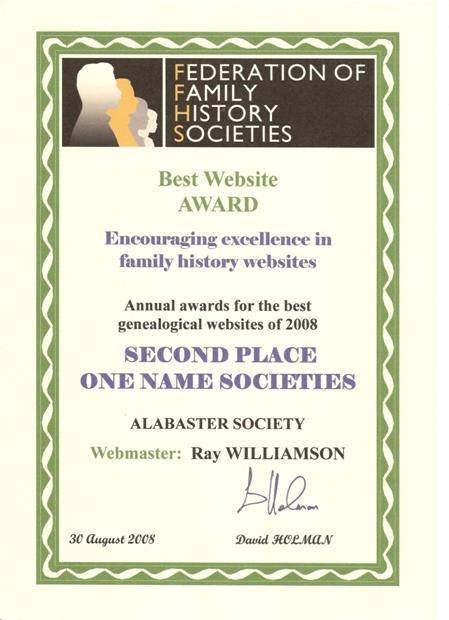
One Name Studies -- Second Prize
To Contents


Yachting Matters to Jim Alabaster

EVER WANTED TO KNOW WHAT LIFE COULD BE LIKE IF YOU CASHED IN YOUR PREMIUM BONDS AND FINALLY GOT AROUND TO HAVING YOUR LUXURY YACHT BUILT?

TAKEN FROM THE PERIODICAL YACHTING MATTERS -- where the photos all show that it never rains on a luxury yacht.

Extracts from an interview with Jim Alabaster, a renowned and highly respected owners` representative within the superyacht industry, at his home in Perran-ar-Worthal, situated very close to Truro in Cornwall.

Jim Alabaster, Luxury Yacht Project Manager

* Jim, going back to your childhood and your roots?

I was born in Bexley in Kent just before the 2nd World War. I lived in Farnborough, Kent, close to Biggin Hill; I would collect shrapnel on the way to school and would often see the planes in aerial combat. 'Flying Bombs' known as the V1 were a daily occurrence. So long as the engine was running we ignored them.

* After your junior school years where did you go?

When I was 10 or 11 I went to Westbrook House School in Folkestone which was a Preparatory School and then from there, when I was 13, I went to the King's School, Canterbury. I loved it at both of the schools.

* And after that, university?

Yes, I followed this by studying Engineering at King's College, London University, and after that I was called up to do my National Service in the Royal Air Force, which was hard work but we had a lot of fun as well. I was among the last intakes before National Service finished. I was trained as a radar fitter alongside other people who were biologists, scientists or degree students. We were paid the princely sum of about £2 a week, which was all you were paid for National Service. All our cars remained in the car park; we could not afford to put fuel in them.

For starters we were taken to RAF Bridgenorth, in Shropshire, for square-bashing; after that I was posted to RAF Locking in Somerset to be trained as a radar fitter, then to the Radio Warfare Engineering Unit at RAF Henlow. It was the time of the Suez war and we were all fearful of being sent there. I then went to the RAF Technical College at Henlow where I trained as an aircraft engineer specialising in Engines and Armament before moving to RAF Conningsby in Lincolnshire where I served as the line armament officer for three squadrons of Vulcan Bombers. That was a fantastic aeroplane and it could climb almost vertically with a full load.

* You were loading atomic weapons.

We were loading weapons, yes. Pretty serious weapons as they were in those days!

* Do you have any good memories of your time in the services?

Yes, obviously -- I was also lucky enough to spend a lot of time sailing. I sailed in the Bristol Channel, racing Yachting World Day Boats from Weston Super Mare when I was on the Hunter unit, and a team raced Firefly Dinghies when I was at Henlow. I won a place in the RAF sailing team, and I received my RAF colours for sailing.

* But from that you obviously picked up a love of the sea.

Yes, although I guess salt is in my blood because my mother's family came from Clydebank in Scotland. I served in the Air Force for about 10 years and then went to Bristol Siddeley Engines as a test engineer on the Olympus engines for the TSR2 fighter bomber, which was eventually scrapped by Harold Wilson's Government. Those engines went on to be developed by Rolls Royce to power the Concorde. After that I worked on the Pegasus engine for the Harrier vertical take off fighter. I began looking for something in sailing and I was recruited by sailmakers in Cowes, Ratsey and Lapthorn. We were very involved with the America's Cup defender's trials between Courageous and Intrepid. We designed a number of sails for Courageous. We would make sails in the City Island loft each day, measure them and rush them to Newport Rhode Island for trials on the boat and rush them back each evening for alterations overnight. That was my initiation into America's Cup racing and I experienced firsthand the competitive selection between two seriously competitive American teams.

* So you later joined with Peter de Savary and his design team to produce a boat - what happened with Victory - tell us the story and about the initial challenge for the America's Cup.

I could write a book about it. I must step back to 1980: Peter felt that in order to have a chance of winning the America's Cup it was important to build a team of people drawn from the best sailors in the country and in order to start that process he decided that he would build a yacht that could compete for a place in the 1981 British Admiral's Cup Team. It was decided that Ed Dubois, one of our leading racing yacht designers, should design the boat and that she would be built in Lymington and named Victory of Burnham....

* Can I just ask you to explain what actually the 12-metre rule is?

Well there is no other way to explain it other than to say it is an International Yacht Racing Rule. It is called the metre class rule, there is a six-metre rule, an eight-metre rule and a twelve-metre rule, the rules allow certain changes: something considered to be advantageous is counter balanced by penalties. For example, if you put more sail area on the boat you must reduce the weight of the keel. If you have a heavier keel to make the boat more stable, you are made to reduce the sail area and so on. It is an interesting rule in that quite different boats do sail at similar speeds.

* So, over the years many yachts have been built for the America's Cup challenges. What happens to them?

I'm not very familiar with the new America's Cup boats, but many of the old twelve metres are still sailing. Many of them are built of wood whereas the rather more modern boats are aluminium. Many of the old boats are still sailing competitively against one another. There is a big fleet of them sailing in Newport and there is another fleet sailing in the Mediterranean. Most of them are beautifully looked after and cared for and they race very seriously

* Ok, so after the America's Cup, we would be looking at 1984, that period. You then stayed with Peter de Savary. What was your next role?

Well my job in 1984 really was to wrap up the Victory Challenge and get rid of all the boats, all the gear, pack up what was left and dispose of it. After that I went to Antigua. Peter had bought the St James's Club, which I think was an old Holiday Inn. I went to Antigua to build the dock at Mamora Bay and dredge the entrance so that the Club was accessible to the larger visiting yachts. We also created a Yacht Club and I was the Commodore.

* Being a captain in the 80's and 90's, did you need any papers, did you have any papers?

I have had a lot of experience on sailing boats and I have an RYA Ocean Yachtmaster certificate. That doesn't qualify me today but it was sufficient in those days and I am still qualified to captain a private yacht.

* Would you want to now?

Not a chance. I do love building them still and expect to do so for some time!

* You stepped on Aviva as an owner's representative: you are one of the few people in this industry to take on that role. Explain to me what you see your role as.

I try to understand what the owner wants when he signs the contract. He would normally sign up the designer or a naval architect plus an interior designer and I try to understand the requirements for his boat and to interpret his wishes so that, when the boat is completed, all of his visions of the yacht come true, all the things that he may not be familiar with have been done properly and in accordance with his wishes and in accordance with the relevant rules and regulations.

* What are your feelings on these really large sailboats that they are bringing out now?

Great-great-grandfather said that you shouldn't build something bigger than a man can handle. Harry Spencer, the famous yacht rigger, said it to me once and I remember him saying it. How wise. You may argue with me today that one can handle very large sailing yachts with huge rigs because there is machinery that will help and materials are stronger, -- which is true. When things go wrong problems can very quickly get out of control because men on their own can't handle the loads. The loads are far too great and machinery is required to handle them. If it breaks, it can create a problem. The old sailing ships had relatively small sails that men were strong enough to handle. Enough said?

* As a representative what would you advise, what kind of a coatings contract would you look for. Would you say a paint job should last three years, four years?

No you can't say that. In general paint will settle down in the first year as will the structure of the boat. The surfaces will contract and the paint may dull depending on the treatment it gets and what kind of paint is used, and how it is applied. Once the yacht has moved around in the sea and the sun and salt have attacked the paint surface it will almost certainly change. Often the boat is better if it is re-painted a year later but that is very expensive when the boat has just been launched. The solvents in the paint and in the fillers evaporate very slowly. This process goes on during the vessel's first year of service. Repainting has its problems: removing all of the deck fittings and windows is the best way and that is expensive. If you mask off you are going to get an edge.

* What can you tell us about decks?

It is very hard to find good quality natural teak because it's very rare. If you can find good teak it will be very expensive so be prepared for the cost.

* Going to the interior of the yachts, take the galley for example - would you be involved with the galley?

One has to try and understand how the galley will be used by the crew, how the chef will work within the space, where will the chef store his supplies, how will the chef access the food? It can also be influenced by the likes and the dislikes of the owner. Does he like a deck-side meal or does he like it served at the table? Does he want the food plated up in the galley before it goes out to the deck? How much noise will he tolerate from the dining table to the galley? All very important considerations that vary from boat to boat.

* The Engine room - who specifies the engines?

Generally it's the naval architect. The owner can have a particular requirement for a type of engine: servicing requirements, area of the world requirements or power requirements for boat speed.

You can commission and build a boat with no crew. An experienced captain can walk onto a boat with a green crew and he can very quickly make it all work. In my experience hiring crew early can be a mistake; they soon get bored of sitting around the yard for a year away from the sea. There are important jobs that experienced crew are required to do, how much linen is required and where is it best stowed? Glassware, china, cleaning items, all of the hundreds of items required on board need to be listed, purchased, inventoried and properly stowed, it is a huge task and it has to be thought about and it must be done before the vessel is handed over.

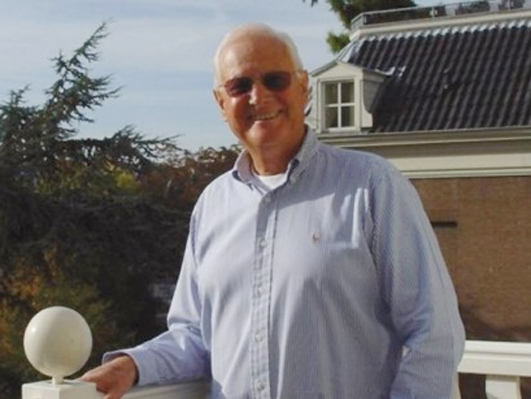
Postscript: we regret to report that Jim Alabaster died on the 30th July, 2010. We are also sorry to have to point out that the picture which accompanies this article in the printed version of Chronicle 30 is not of Mr. Jim Alabaster.

To Contents


Kabbalah

by Sheelagh Alabaster

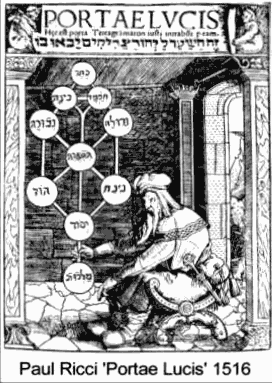
Portae Lucis, Paul RicciLast Wednesday at my How To Crochet A Poem class I found myself sitting next to a man (Michael Berg) who has spent the last thirty years delving into cabbalistic writings. He has just written a novel (A Dream Untold) on the subject. I mentioned William A and he quickly replied with knowledge of the Fludd connection. I printed off for him the section of the translation we put into the Chronicle, hoping at least to get a list of books that might be helpful for anyone wanting to go into this further. In reply he wrote:

Hi Sheelagh, Found this article on Christian Kabbalah - lots of good background & mentions that translations of Sefer Yetzirah & Bahir were made & available in the 16th c.:
http://www.gangleri.nl/articles/36/christian-cabala

I have had a look at the translation - initial comments:
1. The preface states his position in interpreting the scriptures with various allusions. I think it can be summarised quoting from one of my books on Kabbalah:
"It is said that there are four ways to perceive the scriptures. The first is literally, the second allegorically, the third philosophically and the fourth mystically. In this last mode, direct cognition penetrates the simple account, the poetic image and metaphysical conclusions to bring about a personal experience of the Hidden Wisdom. The mystical approach is the basis of Kabbalah."
2. His commentary on the extract from Genesis seems to be drawn from two ancient Kabbalistic books, - the Sefer Yetzirah (Book of Creation/Formation) which is said to have been written by Abraham, but is certainly BC and the Bahir (around 4c) which is a commentary on the Sefer Yetzirah.
The Sefer Yetzirah asserts that there were 32 tools of creation - the ten numbers and 22 letters of the hebrew alphabet. Much is then made of number and letter combinations to make the universe and all in it manifest. This is essentially what William is doing in this extract as he probably had access to these texts. Not sure how deep you want to go into all this, so I'll leave it there for now.
3. Some reference books:
Short accessible work on Kabbalah "Fundamentals of Jewish Mysticism and Kabbalah" by Ron Feldman (available on Amazon).
Key academic work "Kabbalah" by Gershom Scholem has a few pages on the Christian Kabbalah.
As I mentioned to you, Alabaster was a contemporary of Robert Fludd, about whom much has been written. The book I have is by Jocelyn Goodwin: "Robert Fludd: Hermetic Philosopher and surveyor of two worlds". This is out of print, but secondhand copies are available through www.abebooks.com . Of interest to you would be the chapter on his Kabbalistic writings.
There were a number of books about Robert Fludd on Amazon, including one entitled "Robert Fludd and Kabbalah".
Hope this helps,
Michael.

To Contents


Births, Marriages, Deaths

WofW Branch
* Katie Annabelle Alabaster born Chelmsford, 7 July 2008, daughter of Malcolm Alabaster.
* Eileen Louisa Alabaster (nee Hickmott) died 13 July 2008 aged 76, wife of William, mother of Matthew and grandmother of Sophie. They all attended the 2008 Gathering.

Branch IIA
* Andrew James Alabaster, son of Colin, married Lizzie Clarke on 4 October 2008.

Branch IIC
* Otto Maximilian Veldhuis born 21 Nov 2008.
Grandson of Oriole Veldhuis, descendant of Mary Ann Rebecca Criddle (nee Alabaster).
* Ann (Nan) Criddle Kenyon died 25 Dec 2008 in Penticton, B.C.Canada, gt granddaughter of Mary Ann Rebecca Alabaster, granddaughter of Percy Criddle: she was the source of our knowledge of the descendants of the Criddle family in Canada.

Branch IIIA
* Margaret Alabaster (nee Millar) died 22 October 2008 in Armidale, Australia. mother of Gordon and Nigel Alabaster.

Branch IV
* Joseph John Lovelock born 21 May 2008, and...
* Abraham Littlewood Graham born 5 September 2008, both grandsons of Kathryn Graham, descendants of Henry William West Alabaster.
* Petra Knobloch, daughter of Valerie, married Philipp Neu 24 October 2008, and...
* Boris Knobloch, son of Valerie, married Tabea Schulz 30 December 2008, both descendants of Virtue, daughter of Henry William West Alabaster.

To Contents


Return to the first part and Contents list of Alabaster Chronicle No 30
Continue on to the final part of Alabaster Chronicle No 30