|
Pearl Teasdale (IV) Oct 2008:
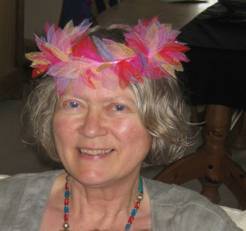
PT Hello Laraine,I'd like to introduce myself, as another member of the huge Alabaster family. My name is Pearl
Teasdale and I live in a small village in North Buckinghamshire, but my brother and I, as well as my parents and many
members of my extended family, were born in East London.
I have been researching my father's family of De'Bell for a while with help from my nephew and his wife (Keith and
Patricia De'Bell) who live in Canada. we got a bit stuck, so Patricia decided to look into the Haines family (my
paternal grandmother's name is Amelia Lillian Haines and she married Samuel De'Bell at West Ham in 1896). I did
not know Amelia Lilian's mother's name as my great-grandmother was always referred to as "Grandma
Haines", Patricia’s research found Amelia Lilian's parents: John Haines married to Virtue. We were delighted to learn
the Christian names of my great-grandparents, but Patricia was determined to research the maiden name of Virtue. At
last we learned she is Virtue West Alabaster. What a fantastic name! I was particularly interested in reading your
account of Virtue's father, Henry William West Alabaster (another "skeleton" in our family's cupboard!), in the
Chronicle of Spring 1995. It was also exciting to read the e-mail from Valerie Knobloch, sent after the
Alabaster gathering in 2005 (published in that year's Autumn Chronicle) as she, like me, is a great grand-daughter of
Virtue West Alabaster. And what a lovely photograph, taken in Australia, entitled "Virtue's Rewards". Now it is time
to pass on all this glorious information to my own children and grandchildren. What fun!
LH What a lovely letter. We welcomed Pearl with open arms.
Laraine Hake to Kelley Videbeck 1 March 2009:
LH I wrote to Kelley, descendant of Captain Daniel Alabaster after whom Lake Alabaster in New Zealand is named.
Have you come across this new website yet? http://www.bdmhistoricalrecords.identityservices.govt.nz/Home/
One interesting marriage it has thrown up is: 1884 Isabella Alabaster to John Halloa
I could not find a suitable birth of an Isabella Alabaster but it has now occurred to me that this could be Isabella
Fenwick, estranged wife of Daniel Alabaster and your 3 x gt grandmother! We know that they were having problems
in 1881 - there was a newspaper report that you sent to me - but I wondered what the early divorce laws were like in
NZ? Have you any idea? On the other hand, if she was as difficult as Daniel indicated, she might have married
bigamously I guess! Aren't ancestors fun?
And Kelley replied:
KV OH MY!!! Thank you so much for this, I had no idea this service was even available, and what an incredible
breakthrough, I am sure this must be our Isabella! I have also found her death in 1891 and so have ordered both
copies. Daniel remarried as a widower in early 1892, so at least he waited until it was legal & proper. And he is the
one who was always given the hard rap by all the family for having run out on his poor wife & mother of his children.
As for Isabella - she has gone from being quite the saintly hard done-by ancestress to a proper old character. It is all
so fascinating!
If only our ancestors had known that the Truth would catch them out - eventually! 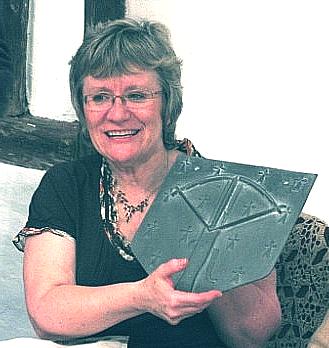
John Stammers Alabaster (I) 24 March 2009:
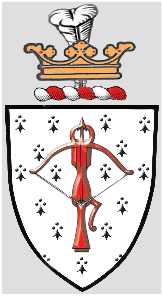
JST Following the last Alabaster Gathering, sales of the castings
in lead of the Alabaster Coat of Arms have now totalled 17,
raising £343 for the charity chosen by Brian for disadvantaged
children, Learning Through Leisure (the odd £3 being an extra
from one of the recipients) and £95 for the Alabaster Society.
James Alabaster (IIC) 24 March 2009:
JA I was intrigued to see "my" photograph in the latest Alabaster
Chronicle.
I'm a Dutchman!
The photograph is Henk Wiekens a local boat builder in Falmouth
originally from Holland. I doubt he will see it as he is unlikely to
read the chronicle but it's not me!
LH Jim was my first cousin, once removed, being the son of
Sidney Herbert Alabaster, brother of my grandmother, by a late
second marriage. This was his typical response to a mistake we
had made.
(Editors' note: NB use of editorial we to indicate that from Issue 32 Laraine will be resuming the office of Editor.
However, from the Office of Outgoing Interim Supply Editor, I would like to ensure that everyone knows IT WAS ME.
Signed, Anon. PS from a different Anon: the OISE really meant to write "it was I").
LH In the use of a photograph to illustrate an article he had written which was included in Chronicle Number 30, very
tongue in cheek, a great sense of humour. Sadly Jim passed away at the end of July after an illness lasting 10 months.
In retrospect, he must have been ill when he wrote to me last, but he did not let it show, bless him.
Ebon Alabastur 24 May 2009:
My family is Jewish and the surname has been Alabaster since before the Spanish Inquisition. My Aunt who is dead
had a genealogical survey done before WW II and found that we were originally from Spain and the name was
Alabastro. They got the name because they were artisans who sculpted in alabaster.
During the Spanish Inquisition they fled to Italy, Bavaria, and England. I think that your original Alabaster may have
been a Jewish Immigrant who intermarried and became Christian. Today, most of the family here in America have
taken the name Albert, but there still are Alabasters floating around. My grandfather changed his name to Albert, I
changed my name back to Alabaster, but spell it with a u, since everyone thought that I made up the name. No one
has asked since I changed the spelling.
I do not know where the Family Tree document is that my Aunt had prepared, she supposedly gave it to a relative in
New York State, but I have no idea who, or when that was. If she were alive she would have been 105 now. She died
just short of her 100th birthday.
Regards, Ebon Alabastur
LH I have no way to corroborate this, but I think it is interesting even if it does not tie up with what we know about our
Alabaster family. I would be interested to receive any comments.
From a fellow member of the Guild of One Name Studies 25 May 2009:
I don't know if it's of any particular importance, but I came across Horace West Alabaster in researching my own
family history. Such an unusual name wasn't hard to track down on the internet!
Horace appears on the crew list for a small coastal trading brig called The Nimble that sailed out of Yarmouth in the
early 19th c. John GREEN was my ggg grandfather and was master of a number of Yarmouth ships over the years. Not
a huge bit of information but, as these crew lists are not published, perhaps something you wouldn't otherwise have
come across.
Crew List January - June 1839
John Green shown as Master. Voyages - Yarmouth to Grainsmouth (Grangemouth?) to Newcastle to Holloway to
Newcastle to Yarmouth to Newcastle to Yarmouth to Newcastle to Yarmouth
John Green 43 b Haisboro Master
William Annison 37 b Yarmouth Mate
William Myall 30 b Beccles
James Cox 39 b Yarmouth
Horace West Alabaster, an apprentice
Christine Drake, (nee Alabaster), London, Ontario, Canada, 23 June 2009:
CD My maiden name is Alabaster and I was born in Canada in 1951 to Clifford Alabaster and Ena Alabaster. I have 3
older siblings all born in England during and after the war. My father was stationed in England in Yorkshire during the
war where he met my mother and they emigrated to Canada in 1947.My father's father was Horace Edmund Alabaster
born in 1887 and he came to Canada around 1914.He married my grandmother, Olive Rose Lyons and they had 3
children, Norman, 1916-1997, Glynn, 1918-1979, and my Dad, Clifford 1920- 996.My grandparents separated when my
Dad was a baby, so I never knew him and he lived in Toronto, Ontario. I find the information fascinating because this
is my family and I didn't know there were so many of us around the world.
LH This was one of those stupendous emails for me to open. Horace Edmund Alabaster was the brother of my
grandmother, Adeline Bertha Alabaster, and the last of her siblings that I had not been able to trace despite my
efforts. Absolutely fantastic for me!
I was on to it like a shot and the outcome was the meeting of second cousins that we held at the end of August
-details elsewhere in this Chronicle.
I had previously searched Canadian records for Horace with no luck, having been told years ago that "he went to
Canada before the first world war". It occurred to me later, to ask Myrna Pacquette to look at the Canadian records
further for me, particularly now that we had a specific location for him. Just one day later -
Myrna Pacquette (IIC) 10 August 2009:
MP A Horace E. Alabaster, age 19, born in Essex, England, arrived in Saint John, New Brunswick in April 1906 -
departed from Liverpool, England on the "Lake Erie" - en route to Toronto.
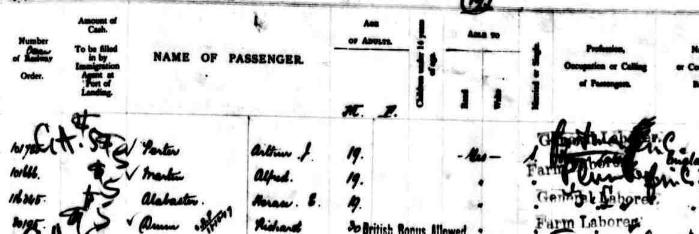
He paid a visit to England in 1926, returning on the "Montclare" arriving in Montreal on 25 September 1926, going
back to Toronto. States that he had lived in Canada from 1906 until August 1926.
Marriage record: Horace Alabaster, son of Thomas and Cordelia Alabaster, 1915 married Olive Rose Lyons in
Toronto. Strangely, he gave his place of birth as United States. Her parents were John Lyons and Rose Hoy. She was
21 yrs old, born in Scarborough, Ontario. He was Methodist, she was Catholic.
In 1901, Olive Rose Lyons, age 8, born 11 May 1893 - parents, sister Mable and brother Andrew.
In 1911, Olive Rose Lyons, age 17, (born May 1893) lived with her parents in Toronto Centre, with a brother, Andrew
(age 25).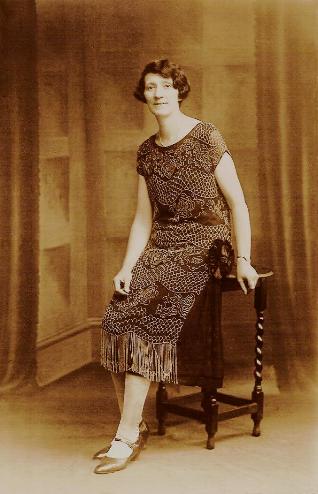
A "Lyons" family tree on ancestry.ca has Olive's death as 1969 in
London, Ontario. Her parents John Lyons (1856-1917) and Rose
Hoy (1860 - 1946).
Sons of Olive Rose Lyons and Horace Edmund Alabaster were:
Clifford John, Glynn Gordon, Norman Horace. No birth dates.
LH Myrna also sent me images of each of these sources of
information, as in the cropped piece from the purser's passenger
list showing Horace arriving in Canada in 1906. Wonderful!
Tony Springall (IIA) 28 August 2009:
AS Yesterday I came across a St John`s Road Girls` School, Hoxton,
register entry for an Emily Alabaster (LMA X095/16) whilst chasing
up another family. The basic facts are that she is the daughter of
Alfred of 104 Wenlock St, was born on 12/7/1889 and admitted to
the school on 26/8/1901, previously having attended Napier St
School.
LH Emily was the daughter of Alfred and Mary (nee Onions), IIIB
and the sister of the mother of Raymond Williamson, our esteemed
webmaster, who sent us this photograph.
Emily Alabaster,
Ray Williamson's Auntie Em
|