|
From Simon Mundy IIC 23rd November 2007
I knew of my mother Phryne’s and my aunt Audrey’s interest in the Alabaster Society and today while looking for
some information in the internet on Geoffrey Alabaster I came across your website along with a short article you
wrote in Chronicle number 20 Spring-Summer 2003. Just in case none of the family in England informed you at the
time, Phryne passed away on 5th February 2005 in Barcelona, Spain where she lived the last 4 years of her life with
us.
Regarding your mention of Geoffrey Alabaster, Henry Alabaster and the Electrical Review. Yes, Geoffrey was Audrey
and Phryne’s father – my grandfather who died when I was one year old. As far as I can remember from family
comments, the Electrical Review (which I understood from Phryne still exists today as a specialised publication
within a big publishing group) was started and owned by Henry Alabaster, their grandfather, who was an electrical
engineer as well as Royal Academy painter. A prize collection of large charcoal drawings was unfortunately lost in
London during one of Audrey’s many changes of residence. Well, it was certainly a pleasant surprise to see their
names on the internet this morning! Kind regards,Simon.
From Jackie Settle 30th November 2007
Thank you for introducing me to Shirley. Our correspondence goes back and forth now.
I was in Birmingham Central Library yesterday and came across an Alabaster name so copied it down. You may have
this information of course.
Baptism: St Paul Balsall Heath Arthur Stanley Alabaster born 9th May 1884 Baptised 7th June 1884 Parents Arthur
and Catherine Alabaster Abode Ombersley Terrace Moseley Rd, Balsall Heath. Occupation Traveller
(Jackie Settle is a family historian whom I was able to put in touch with Shirley Rowe a few months ago; they share
Clark ancestors). Now that I have entered these details on my tree I find that I did not previously even have the date
of birth, other than the quarter from the GRO indexes of Arthur Stanley Alabaster although I did know who he was.
Arthur Stanley's son and grandchildren are members of the Alabaster Society. His father, Arthur, was one of the
founders of Alabaster & Wilson, the jewellers, which is still a family concern today.
http://www.alabasterandwilson.com/
Probably of more interest to you, Jackie, is that Arthur Stanley was actually the son of Edward Alabaster who was the
brother of James Alabaster who was the father of Emma who married Thomas Sidney Clark - Arthur Stanley was
Emma's first cousin! Now that IS interesting! Thank you very much! Laraine.
From Julia Alabaster (IIA) 6th December 2007
Just to let you know that the Alabaster Chronicle arrived today.
I notice that you say that Alabaster & Batey were taken over by R.Whites. Canada Dry ( Charringtons ) bought the firm
in the early 1950's, but they may have sold on to R.Whites of course. A drink called " Alabasters Sparkling Muscado ",
a non alcoholic grape wine, was I think made under licence in the north of England for some time after the sale.
As Julia is the granddaughter of John Alabaster, one of the two brothers who bought out Batey Bros., I am sure she is
more likely to be correct than I am! Thank you, Julia.
From Valerie Knobloch (IV) 24th January 2008
Annie May Knobloch, born 20.12.2007 May we wish you all a very PEACEFUL AND HAPPY NEW YEAR 2008.
From Hadleigh Market Feoffment Charity28 January 2008
I am pleased to inform you that at a recent meeting of the Charity it was agreed to offer you a 20% discount on the
meetings that you hold at the Complex on alternate years.
Judith Townsend, Administration Office and Booking Clerk
From Susan Atkins Scotchmer: One-Name Study
I have just been going through some Scotchmer documents which I photographed at Suffolk R.O. in Ipswich last year
and have found a will for a Mary Scotchmer dated 1673 where one of the witnesses is a Bridget Alabaster. I attach a
copy of the photographed will for your information. Mary Scotchmer was living at Somersham, Suffolk, when she made
the will.
Susan is a fellow member of the Guild of One Name Studies (GOONS*) I was very grateful to her for this information
which I passed on to Tony to help assess its usefulness to us.
From Tony Springall
Thank you for forwarding the Will. As I am sure you know, Bridget was the daughter of the John Alabaster (son of
Thomas) who migrated from Hadleigh to Sibton to Offton to Somersham and then Baylham. The Will is useful in that
it now establishes that John and his family stayed in Somersham for at least 3 years before moving to Baylham. It
also raises the issue of when she was born. She was baptized in Hadleigh on 16 March 1658/9 (with other children of
John & Elizabeth being baptized in earlier years) and thus if she was born that year she would only have been 14
when she witnessed the Will. Could someone so young have legally witnessed a Will in those times or was she much
older? I have corrected the image of the Will for perspective to make it slightly easier to read and attach a copy
From Sue Hedges 31st March 2008
Sue Hedges, another fellow member of GOONS*, kindly pointed out that the medal of:
"Private H. Alabaster of Middlesex Regiment - Queens South Africa Medal with six clasps is up for auction at
www.wellingtonauctions.com If you go to the online April Auction and look at item number 72. "
The information given on the site was:Queens South Africa Medal, six clasps, Cape Colony, Tugela Heights, Orange
Free State, Relief of Ladysmith, Transvaal and Laing’s Nek, named to 3181 Private H. Alabaster, Middlesex
Regiment.
I am not immediately able to identify H. Alabaster but surely I should have sufficient information here to be able to do
so. Any suggestions would be much appreciated!
From Tony Springall – 1st April 2008
We arrived back yesterday evening after a fabulous trip (to New Zealand). We met with Molly Duffy in Dunedin. She
was lovely and asked to be remembered to you. I will tell you the details later.
Molly Duffy is a member of Branch IIC and is descended from Rev Charles Alabaster who went to New Zealand in
1859. I still get a thrill when something happens on the other side of the world, as with Molly and Tony meeting up in
New Zealand, because of the Alabaster Society!
From Ivor Smith 28th April 2008
Managed to get in at last and got these results – I think I know some of these characters!
Ivor had managed to access some wonderful details from the Old Bailey records that are now available on-line,
involving Alabasters in various guises - from victim, witness, accused, convicted criminal, police officer, employer,
bystander, name of a road through to the material of which the stolen vase was made. This will make great copy for a
future edition of the Chronicle! Watch this space.
From Sheelagh Neuling 16th June 2008
Dear Laraine, very sad to report that my uncle Peter Alabaster has died.- father of Paul, Wendy, Stephen and David.
Sheelagh.
From Lesley Morris 17th June 2008
I recently found the Alabaster Society on the web after searching for information about my ancestors. My great
grandfather was William Parker (1846 - 1896) and my great grandmother was Elizabeth Bolton (1852 - 1900). They
were married at St Thomas' Church, Bethnal Green on May 1872. The witnesses to the marriage were John and
Martha Alabaster. I have found your web site very interesting and a great insight into life in East London in the 1800s.
I am fascinated by the information you have given me. My first thought was that I would be able to tell you all about
John and Martha Alabaster because a bell rang in my head that she was Martha Parker originally. Well, she was, but
it never as straight forward as that, is it?!
Well, John Alabaster and Martha, nee Parker had six children between 1855 and 1870, however, I have not been able
to identify a marriage for them, despite having all the Alabaster marriages from the GRO indexes. Martha's maiden
name comes from the birth certificates of two of her children; John who was born 19 July 1855 at 13 Charlotte Street,
Bethnal Green and James Henry who was born 20 March 1862 at 5 New Street. I don't have the birth certificates of
the other four but I do have some of their baptisms. Another complication is that John, father of the children, died 8
October 1869 at 26 Boundary Street, Bethnal Green at the age of 35. Martha Alabaster was the informant, so it
clearly was not this John who was the witness - perhaps it was the eldest son.
The 1871 census finds Martha as a widow, aged 32, a matchbox maker, living at 26 Old Nichol Street, with her five
surviving children, the youngest of whom was 10 months old - bit tight to be the daughter of John, come to think of it -
no, that's not fair! 10 + 9 = 19 months. 19 months before the 1871 census would have been Sept/Oct 1869. Well,
pretty tight.
By 1881 she was living at 116 Hanbury St, Mile End New Town with a George Young and a daughter Caroline, and
three of her Alabaster children which is how I identified her. Once again, I have not found a marriage but then I would
only have looked under Alabaster and she could have married him as Martha Parker.
I have given this much detail because I am assuming that she would be likely to have been a relation of your gt
grandfather, William. If Martha was born about 1837 she could well have been a older sister I guess.
- Just attempted to check out the 1851 census but there is no sign of a Martha Parker bn 1837 Shoreditch. Curiouser
and curiouser. Do you know where your William was born? Have you found him on the 1851 census? Where was he
living when he married?
21st June Lesley replied:
I have been unable to find out anything about my g.grandfather William James Parker before his marriage. William
was a cigar maker and as far as I can tell was born and lived in Bethnal Green all his life. His first marriage in 1867
was to Elizabeth Elliott. Residence at time of marriage just says Bethnal Green. The witnesses were William Biggs
and Jane Elizabeth Chartier. I can find no record of Elizabeth's death but William (a widower) married again in 1872 to
Elizabeth Bolton. Residence at time of marriage was Gibraltar Walk, BG. The Alabasters were witnesses to this
marriage. On both marriage certificates William states that his father was also a cigar maker and named William
James Parker.
The 1881 & 1891 census show William and Elizabeth living at 2 Albion Buildings, BG. They had fourteen children....my
grandmother being their youngest. William died in 1896 in the workhouse at the age of 50 (Elizabeth was with him).
Elizabeth died four years later in 1900. The 1901 census shows the children living at 2 Ermest Place, BG and
interestingly a John Parker (b.1849 in Shoreditch) and his wife Ann Parker (b.1841 in Whitechapel) were living at that
address. I wonder if John was William's brother? I had no idea that Martha was a Parker when I contacted you. So all
we need to find now is a Martha, William and John living as children with their father William James Parker! Oh, if
only it was that easy! Thank you once again Laraine for all your information. It is the extra details that bring our
ancestors to life (so to speak). I'll keep looking and will contact you should I find anything new about the Parkers.
And there was more from Lesley:25th June 2008
About a year ago I sent off for what I thought might be my g.grandfather's (William James Parker) birth certificate. I
was delighted when it arrived as it seemed to tie in well with the details I knew. He was born in 1846 and as he had
been a cigar maker all his life it seemed sensible that his father had been a cigar stripper. The certificate showed
that his father was James Parker and his mother Hannah Parker (neé Smith).I could only find them in the 1861 census
living in Reform Place, St Lukes, Finsbury. Following this line I send off for James Parker's death certificate. For
various reasons (mainly because by that time I had received William James Parkers' marriage certificates which
stated that his father was called William) I decided that I was following the wrong line. However on getting your
e.mail about Martha Parker / Alabaster / Young something rang a bell and I got the death certificate out again. Low
and behold the informant was Martha Young! She was living in Turville Street, Bethnal Green in 1874.
So, it would appear that Martha's parents were James and Hannah. I am still wondering were my William fits in. Why
would he state that his father's name was William when it was James?
Also, I found another Martha Alabaster born in 1837 and married to a John James Alabaster, a chairmaker. In the 1881
census they were living in Austin Street. Are they also members of your Alabaster family? I wondered if they were the
Martha and John who witnessed William's marriage? All very complicated and my head is spinning!
25th June 2008 – I received an telephone call from Patricia Powell.
She had found the website and realized that she was descended from Emily Florence Millington, the daughter of
Caroline Alabaster who married George William Millington. Caroline was the daughter of Samuel West
Alabaster…………It is only very recently that we have found any descendants of Samuel; he was the eldest son of Robert
Alabaster and Mary Ann (nee West) who lived in Gt Yarmouth for much of their lives (Branch IV) Bob Perry who was
with us at the Gathering is also descended from a daughter of Caroline, and now there was another!
From Carol Millington-Pratt 30th June 2008
I've just discovered your amazing website. I'm distantly related to Caroline Alabaster who married George William
Millington in1864. George William's brother, Joseph Millington, was my great grandfather. I was recently contacted
by Patricia Powell who is researching her family history. She is the granddaughter of Emily Florence Millington,
Caroline's daughter. If you have any information about Caroline and George William's family I would be very grateful.
As someone once said, 'Isn't it a small world?'
From Ray Williamson 9th July 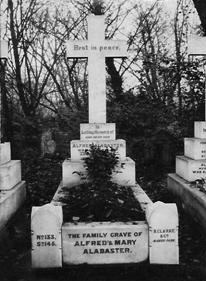
I have photos of Alfred & Mary`s family grave in Manor Park Cemetery in London. I
hope to go there and take more up-to-date pictures. I know there are at least two
family graves which are next to each other. Do you know of others?
I do know of other burials in Manor Park Cemetery, actually, although not always in
a lot of detail.
Firstly, some of the brothers and sisters of my grandmother were buried there,
according the Family Bible, although whether they would have had a grave with a
stone I do not know. They were:Cordelia Catherine Alabaster, died 8 April 1887,
aged 9 Alfred Ernest Alabaster, died 14 Dec 1879, aged 3 weeksWalter Ambrose
Alabaster, died 23 June 1883, aged 4 months
Of more interest to you is the following information from Branch IIIB:
John James Alabaster died 11 January 1888, aged 54. He is buried in Grave No. 399,
Square 148;
his wife Martha Alabaster 3 June 1903 aged 66. She is buried in square 145, No.40;
their son, Edward Alabaster, died 24 Dec 1932 aged 61, also buried in square 145,
No 40;
son William, died 12 August 1927, aged 65 square 145, No 40;
son Walter died 16 Aug 1898 aged 34, same grave!
son Joseph died 1 Feb 1900,, aged 32, same grave;
son William died 23 April 1936, same grave............and it is at this point that I notice that the person who told me
about this was 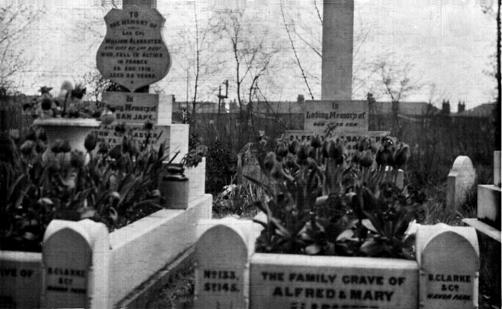 YOUR COUSIN ELSIE so I guess this is the other grave that you knew about all the time! Never mind, I
will complete it in any case! son
George, died 27 Fb 1955, aged 79 YOUR COUSIN ELSIE so I guess this is the other grave that you knew about all the time! Never mind, I
will complete it in any case! son
George, died 27 Fb 1955, aged 79
And of course, now I check it out, your
grandfather, Alfred, was another son
of John James and Martha!
Ray replied: Thank you very much for
all that information. I shall go and
take new photographs when I can.
On the grave next to No 133 Sq 145
(pictured left) there is an inscription
to Lce Cpl William Alabaster, 2nd City
of London Regt, who fell in action in
France 26 Aug 1916 aged 25
years,and one for Susan Jane, and one
for John Alabaster.
The graves are all in the
south-eastern corner of Manor Park Cemetery, near the Whitta Road entrance (pedestrians only).
If you download the plan from http://www.mpark.co.uk/Images/manormap.gif please note that North is to the left.
Poorer people would have been buried in "unpurchased or common graves" with others, presumably without a
headstone, etc.
|

 Sri Lanka President at Britannia Royal Naval
College
Sri Lanka President at Britannia Royal Naval
College
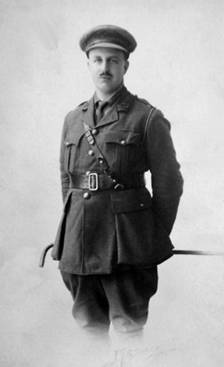 My grandfather was Arthur Stanley Alabaster (IIA). He was married to Mary
Marguerite Glover from Warwick and their two sons were Deryck Stanley James
Alabaster (my father), and Peter Douglas Arthur Alabaster (my uncle). Uncle
Peter we have just so very recently lost, to our great sadness. A few months
before he died I was able to send him copies of material about the military
career of his father, researched by the wonderful Museum staff at The Royal
Regiment of Fusiliers, St John’s House, Warwick.
My grandfather was Arthur Stanley Alabaster (IIA). He was married to Mary
Marguerite Glover from Warwick and their two sons were Deryck Stanley James
Alabaster (my father), and Peter Douglas Arthur Alabaster (my uncle). Uncle
Peter we have just so very recently lost, to our great sadness. A few months
before he died I was able to send him copies of material about the military
career of his father, researched by the wonderful Museum staff at The Royal
Regiment of Fusiliers, St John’s House, Warwick. 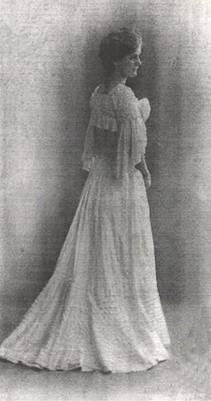 One afternoon in 2007 I had collected my
granddaughter Eloise and taken her to the toy
museum in Warwick. Upstairs in the same
building we found the Regimental Museum of
the Royal Warwickshire Regiment where there
are hats and helmets and splendid jackets to
try on. The attendant overheard me telling
Eloise that her great great grandfather had
worn a hat like the one she was looking at.
Soon we were being offered new information
from Army Lists, and given the opportunity to
request further research about the Alabasters
who had served with the Royal Warwickshire Regiment.
One afternoon in 2007 I had collected my
granddaughter Eloise and taken her to the toy
museum in Warwick. Upstairs in the same
building we found the Regimental Museum of
the Royal Warwickshire Regiment where there
are hats and helmets and splendid jackets to
try on. The attendant overheard me telling
Eloise that her great great grandfather had
worn a hat like the one she was looking at.
Soon we were being offered new information
from Army Lists, and given the opportunity to
request further research about the Alabasters
who had served with the Royal Warwickshire Regiment.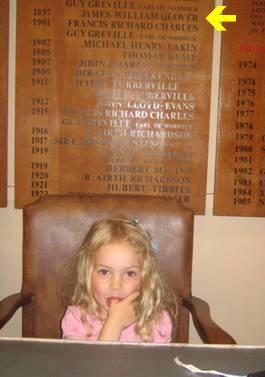 When they heard about this, the ladies scooped us under their
ample arms and rushed us into the
Council Chamber, where Eloise was
invited to sit in the Special Chair, just under her esteemed Glover’s name
(arrowed in the picture to the right).
When they heard about this, the ladies scooped us under their
ample arms and rushed us into the
Council Chamber, where Eloise was
invited to sit in the Special Chair, just under her esteemed Glover’s name
(arrowed in the picture to the right). 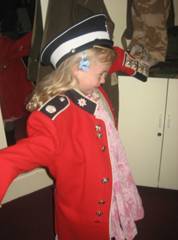 “The 1/5th War Diary shows Captain Alabaster joining them in late November 1915.
The unit was then holding trenches near Gommecourt, with billets at Fonquevillers. This
was in the area that the Battle of the Somme would take place and the battalion
remained there until the offensive began.
“The 1/5th War Diary shows Captain Alabaster joining them in late November 1915.
The unit was then holding trenches near Gommecourt, with billets at Fonquevillers. This
was in the area that the Battle of the Somme would take place and the battalion
remained there until the offensive began.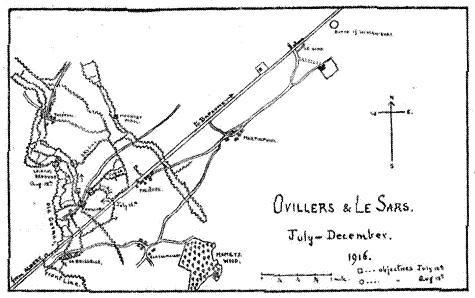
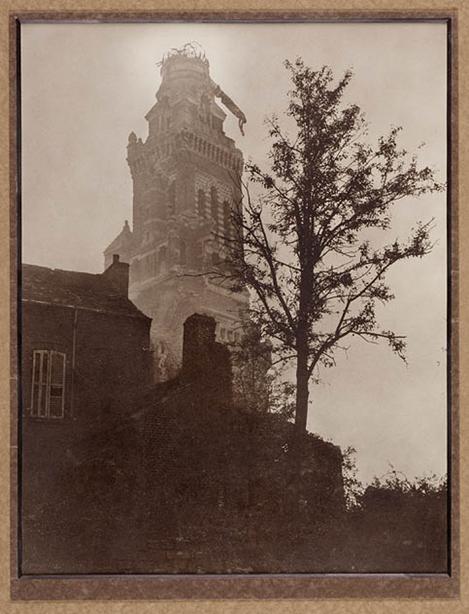 On taking over an enemy dugout –..and a
large dead German was on one of the beds.
The whole place was in a very dirty state..
Down below, the wine cupboards had
evidently received a thorough overhaul,
and bedclothes and French literature of a
frisky nature were strewn about... One of
the entrances had been crushed in by our
guns but otherwise the building was in
first-class condition.
On taking over an enemy dugout –..and a
large dead German was on one of the beds.
The whole place was in a very dirty state..
Down below, the wine cupboards had
evidently received a thorough overhaul,
and bedclothes and French literature of a
frisky nature were strewn about... One of
the entrances had been crushed in by our
guns but otherwise the building was in
first-class condition.